Food Manufacturing License: Malaysia
- Roger Pay
- Aug 14, 2025
- 7 min read
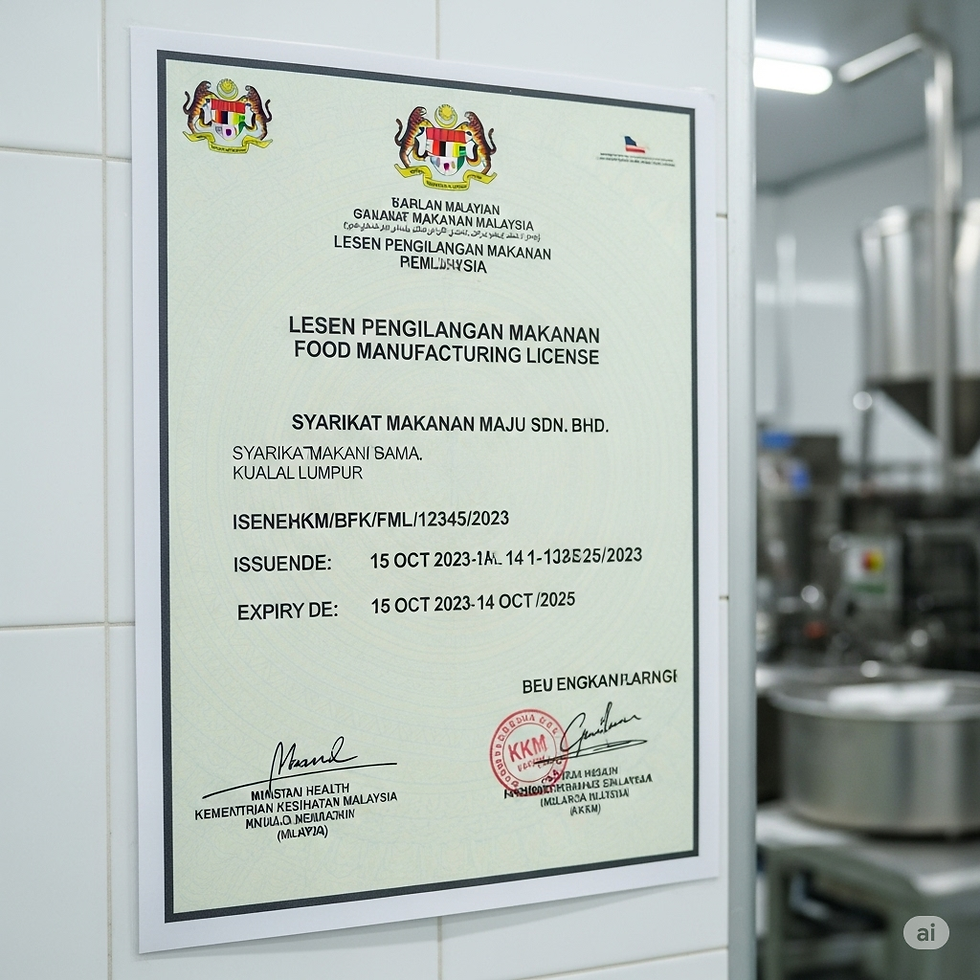
Malaysia Food Manufacturing License Guide
In Malaysia, a food manufacturing business needs to comply with a set of regulations and obtain several licenses and certifications. The specific requirements can vary based on the size and nature of your operation.
Key Licenses and Regulations
1. Manufacturing License (from MIDA)
This license is issued by the Malaysian Investment Development Authority (MIDA) under the Industrial Co-ordination Act 1975 (ICA). It is not a food-specific license but a general manufacturing one. You are required to apply for this if your company meets either of the following criteria:
Shareholders' funds of RM2.5 million and above.
75 or more full-time paid employees.
If your business does not meet these criteria, you can apply for an exemption letter from MIDA. This letter allows you to operate without the full license and may make you eligible for certain government incentives.
2. Food Premises Registration (from Ministry of Health, MOH)
Every food premise, including a manufacturing facility, must be registered with the Ministry of Health (MOH). This is done through the Food Safety Information System of Malaysia (FoSIM) portal. The registration ensures that your facility meets the necessary health and hygiene standards outlined in the Food Act 1983 and the Food Regulations 1985.
3. Food Handler Training and Typhoid Vaccination
All individuals involved in food handling must undergo a Food Handler Training course and receive a typhoid vaccination. This is a mandatory requirement to prevent food contamination.
4. Good Manufacturing Practice (GMP) and Hazard Analysis and Critical Control Point (HACCP) Certifications
While not always mandatory for all businesses, these certifications are highly recommended and often a prerequisite for larger-scale operations or for supplying to certain retailers.
GMP (Good Manufacturing Practice): This certification demonstrates that your facility and processes meet a high standard of hygiene and quality control.
HACCP (Hazard Analysis and Critical Control Point): This is a systematic approach to food safety that identifies and controls potential hazards in the food production process.
Applications for both GMP and HACCP certifications are administered by the Food Safety and Quality Programme under the Ministry of Health.
5. Other Permits and Licenses
In addition to the above, you will also need to secure other permits:
Business Registration: Your company must be registered with the Companies Commission of Malaysia (SSM).
Local Authority Licenses: You will need a business premises license and a signboard license from the local council where your factory is located.
Halal Certification (JAKIM): If you intend to market your products as Halal, you must obtain certification from the Department of Islamic Development Malaysia (JAKIM).
Environmental Permits: Depending on your manufacturing process, you may need permits related to waste disposal and environmental compliance.
Application Process
The application process generally involves these steps:
Company Registration: Register your business with the Companies Commission of Malaysia (SSM).
MIDA Application: Determine if you need a Manufacturing License or an exemption letter from MIDA. Apply through the InvestMalaysia portal.
MOH Registration: Register your food premises and products via the FoSIM system. This is a critical step for all food manufacturers.
Local Council Licenses: Apply for your business and signboard licenses with the relevant local authority.
Staff Training and Vaccination: Ensure all food handlers are properly trained and vaccinated.
Certification: Apply for any additional certifications such as GMP, HACCP, or Halal, as required for your business.
Fees
The fees for a food manufacturing license in Malaysia are not a single, flat rate. They vary depending on the specific licenses and approvals your business needs, as well as the size and nature of your operation.
Key Fees to Expect
Manufacturing License (MIDA): If your company meets the criteria (shareholders' funds of RM2.5 million or more, or 75+ full-time employees), a new Manufacturing License application fee is RM1,500. If your business is exempt from this license, you can apply for an exemption letter for a fee of RM1,000.
Company Registration (SSM): The registration fee for a new company with the Companies Commission of Malaysia (SSM) is around RM1,010, not including any third-party service charges.
Local Authority Licenses: The cost for business premise and signboard licenses from your local council can vary. It's best to check with the specific local authority in the area where your factory will be located.
Food Safety Certifications: Fees for certifications like Good Manufacturing Practice (GMP) or Hazard Analysis and Critical Control Point (HACCP) will depend on the certification body and the scope of your facility.
Halal Certification (JAKIM): If you require Halal certification, there are fees associated with the application, auditing, and renewal process, which vary based on your company's size and product type.
Other Potential Costs: Be aware of other potential costs, such as fees for food handler training and typhoid vaccinations for your employees, and environmental permits if your operations require them.
MOH Registration Fees
The Ministry of Health (MOH) registration process for food premises and products through the FoSIM (Food Safety Information System of Malaysia) portal is a critical step for all food manufacturers in Malaysia.
Here are some key fees associated with the FoSIM system and related services:
Food Premises Registration: While registering the premises itself on FoSIM is generally considered a mandatory step for compliance, the fee structure for this specific registration is not always a simple, single payment. It is a prerequisite for other certifications and processes.
Product-Related Fees: Once your premises are registered, you will need to get your individual products approved. Some fees that have been noted are:
Label Screening: RM 250 per product.
Health Certificate: RM 100 per certificate (up to 25 products) for those with HACCP certification from the MOH.
Halal Certification: While managed by JAKIM, the Halal certification process is deeply linked with the regulatory framework set by MOH. Fees for this certification vary based on the size of the company and the number of products.
Good Manufacturing Practice (GMP) and Hazard Analysis and Critical Control Point (HACCP) Certifications: These are often handled through the MOH, and the fees for these certifications can vary based on the size of your business (e.g., SME vs. big industry) and the complexity of your processes.
Professional Fees
Professional fees for obtaining a food manufacturing license in Malaysia are not fixed and can vary widely. These fees are separate from the government and application fees and cover services provided by Bestar who assists with the application process.
Types of Professional Fees
Consultancy Fees: Many businesses hire Bestar to help navigate the complex licensing and certification process. Bestar assists with:
Regulatory Compliance: Ensuring your facility and processes meet all local and national food safety and manufacturing regulations.
Documentation Preparation: Assisting in the preparation of the extensive paperwork required for applications to agencies like MIDA and the Ministry of Health (MOH).
Facility Audits: Conducting gap analysis and pre-audits to ensure your factory is ready for inspections for certifications like Good Manufacturing Practice (GMP) and Hazard Analysis and Critical Control Point (HACCP).
Training: Providing food safety training for your staff to meet mandatory requirements.
Consultancy fees can range significantly based on the size of your operation and the scope of services needed.
Legal Fees: You may incur legal fees for advice on corporate structuring, intellectual property protection (e.g., trademarks for your products), and drafting contracts with suppliers or distributors.
Certification and Auditing Fees: While some certification bodies are government-affiliated, many are private. Fees for services like Halal certification from JAKIM or other private-sector certifications involve application, auditing, and renewal fees that can be substantial.
Our professional services can streamline the licensing process, help you avoid costly mistakes, and ensure your business is fully compliant from the start. However, they are an additional cost on top of the standard government application and license fees.
How Bestar can Help
Hiring a professional consultant to assist with obtaining a food manufacturing license in Malaysia can be highly beneficial, especially given the complexity of the regulatory landscape. Here's how Bestar can help:
1. Navigating Complex Regulations
Malaysia's food manufacturing regulations are governed by multiple agencies, including the Malaysian Investment Development Authority (MIDA), the Ministry of Health (MOH), and various local councils. Bestar has a deep understanding of these regulations and can guide you through the process, ensuring you meet all legal requirements. This helps you avoid costly mistakes, delays, and potential fines.
2. Streamlining the Application Process
The application for a food manufacturing license involves extensive paperwork and specific documentation. Bestar can:
Conduct a Gap Analysis: We can assess your current operations and facility to identify any areas that do not comply with the regulations.
Prepare Documentation: We will assist in preparing the necessary manuals, procedures, and forms for applications to MIDA, MOH, and other relevant bodies. This ensures all submissions are accurate and complete, reducing the chances of rejection.
Coordinate with Authorities: We act as a liaison between your business and the different government agencies, managing the submission and follow-up of your applications.
3. Ensuring Food Safety and Quality Compliance
Beyond the basic licenses, Bestar can help your business achieve critical food safety certifications that are often required by retailers and for export purposes. These include:
Good Manufacturing Practice (GMP): A consultant can help you develop and implement a GMP-compliant system, which covers everything from facility design and equipment to personal hygiene and sanitation.
Hazard Analysis and Critical Control Point (HACCP): We can assist in creating a HACCP plan, a systematic approach to identifying and controlling food safety hazards. This is crucial for demonstrating a high level of food safety management.
Halal Certification: If your business aims to serve the Muslim market, a consultant specializing in Halal standards can guide you through the application and audit process with JAKIM.
4. Training and Capacity Building
A key part of maintaining compliance is having a knowledgeable staff. A professional consultant can provide:
Food Handler Training: We can offer certified training for your employees on food safety, hygiene, and other mandatory requirements.
Internal Audits: We can conduct internal audits to prepare your team for external inspections by government bodies or certification auditors.
Knowledge Transfer: We will help you establish and maintain a food safety management system that your team can operate autonomously, ensuring long-term compliance.
In essence, Bestar saves you time and resources by providing expert guidance, a structured approach to compliance, and a clear path to obtaining the necessary licenses and certifications. This allows you to focus on your core business—producing high-quality food products—while we handle the regulatory complexities.


Comments