Playbook for Singapore Manufacturers Looking to Expand into Johor
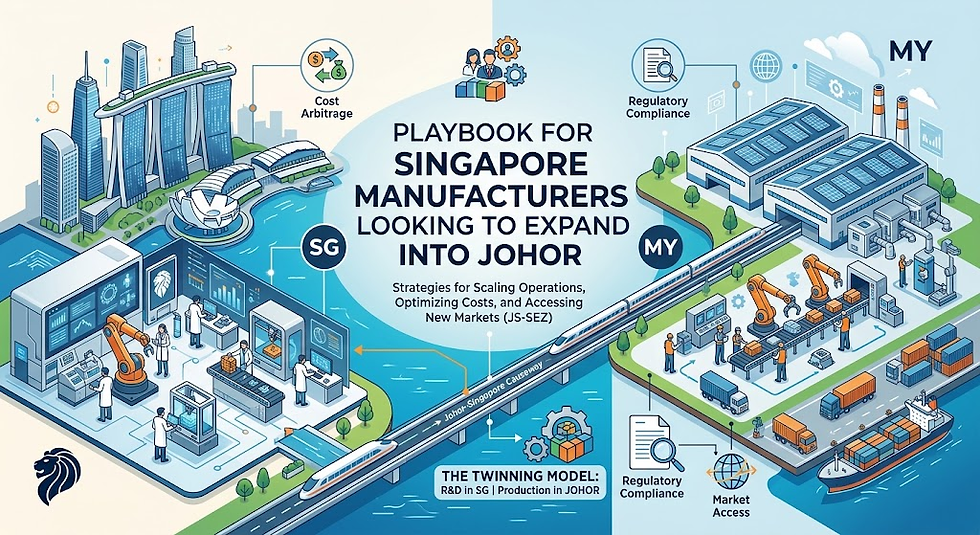
Playbook for Singapore Manufacturers Expanding into Johor (JS-SEZ)
Playbook for Singapore Manufacturers Looking to Expand into Johor
The Johor-Singapore Special Economic Zone (JS-SEZ) has reshaped how Singapore-based manufacturers scale operations. By leveraging the "Twinning Model"—retaining high-value R&D, regional headquarters, and IP management in Singapore while anchoring scalable, land- and labor-intensive production in Johor—manufacturers achieve structural cost resilience without sacrificing global market access.
1. The Strategic Imperative: The Twinning Model
Rising industrial rents, land constraints, and tight labor quotas in Singapore make scaling factory footprints challenging. Expanding across the Causeway provides immediate capacity while keeping supply chains connected.
  SINGAPORE HQ & R&D HUB
  ├── High-value R&D & IP Control
  ├── Regional Treasury & HQ Management
  └── Advanced Prototyping
         │
         │ (24-Hour Cross-Border Freight Corridor)
         ▼
  JOHOR INDUSTRIAL SATELLITE
  ├── Large-Scale Automated Production
  ├── Warehousing & Logistics (Port of Tanjung Pelepas)
  └── Regional Assembly & Export Processing
Core Strategic Pillars
Cost Arbitrage: Reduce factory space and labor expenditure while retaining Singapore-backed institutional credibility.
Geographic Proximity: Same-day access allows engineering teams to travel between HQ and factories within hours via the RTS Link and upgraded land checkpoints.
Rules of Origin Compliance: Maintain supply chain integrity under the Regional Comprehensive Economic Partnership (RCEP) and ASEAN Trade in Goods Agreement (ATIGA).
2. Navigating the JS-SEZ Framework & Key Zones
The JS-SEZ spans over 3,500 km² across nine specialized zones tailored to high-value manufacturing segments.
Zone / Location | Dominant Sector / Target Focus | Key Infrastructure & Logistic Assets |
Kulai – Sedenak | Advanced AI Hardware, Semiconductors, MedTech, Pharma | Sedenak Tech Park, High-Power Grids, Direct Fibre Hubs |
Senai – Skudai | Aerospace Components, Precision Engineering, Automotive | Senai International Airport, Air Freight Terminals |
Iskandar Puteri | Clean Tech, Smart Electronics, Medical Devices | Proximity to Tuas Second Link, EduCity Talent Pipeline |
Pasir Gudang & Tanjung Langsat | Downstream Chemicals, Heavy Machinery, Process Industries | Deepwater Ports, Specialized Chemical Logistics Pipelines |
3. Financial Incentives, Grants, and Tax Optimization
Expanding manufacturers can leverage financial support from both the Singapore and Malaysian governments.
Malaysian Incentives (JS-SEZ Special Package)
Tiered Corporate Tax Rates: Concessional corporate tax rate down to 5% for up to 15 years for qualifying investments exceeding RM1 billion in high-value manufacturing.
Investment Tax Allowance (ITA): 100% ITA on qualifying capital expenditure offset against statutory income for eligible investments.
Duty Exemptions: Full import duty and sales tax exemptions on capital equipment, raw materials, and machinery required for production lines.
Stamp Duty Relief: Up to 40% stamp duty exemption on commercial property transfers within designated zones.
Singapore Bilateral Support
Enterprise Singapore Grants: Tap the Market Readiness Assistance (MRA) grant for initial setup advisories and the Enterprise Financing Scheme (EFS) for facility cross-border financing.
SMF Business Facilitation: The Singapore Manufacturing Federation (SMF), as the official JS-SEZ programme manager, offers direct facilitation via the SETUP Framework.
4. Step-by-Step Expansion Roadmap
Phase 1: Feasibility & Strategy (Months 1–3)
 ├── Sector zoning analysis
 └── Financial model & tax structure design
      │
Phase 2: Entity Setup & Regulatory Clearance (Months 4–6)
 ├── MIDA & IMFC-J submission
 └── SSM incorporation & SST registration
      │
Phase 3: Site Selection & Construction (Months 7–12)
 ├── Ready-built vs Build-to-Suit selection
 └── Facility fit-out & ACA incentives
      │
Phase 4: Operations & Supply Chain Integration (Months 13+)
 ├── Cross-border logistics setup
 └── Workforce onboarding via JTDC
Phase 1: Feasibility & Strategy (Months 1–3)
Conduct sector-specific zoning analysis to match production requirements with industrial parks.
Establish dual-entity corporate structures to manage cross-border transfer pricing, profit repatriation, and tax credits.
Phase 2: Entity Setup & Regulatory Clearance (Months 4–6)
Route investment applications through the Invest Malaysia Facilitation Centre-Johor (IMFC-J) for expedited clearance.
Register business entities with the Companies Commission of Malaysia (SSM) and file for MIDA tax incentive packages.
Phase 3: Site Selection & Construction (Months 7–12)
Evaluate Ready-Built Factories (RBF) for rapid deployment vs. Build-to-Suit (BTS) plots for specialized automation needs.
Utilize Accelerated Capital Allowance (ACA) provisions for industrial facility fit-outs and green technology integrations.
Phase 4: Operations & Supply Chain Integration (Months 13+)
Enroll in the Malaysia-Singapore Authorised Economic Operator (AEO) arrangement for expedited customs processing.
Source technical personnel in coordination with the Johor Talent Development Council (JTDC).
5. Operations, Logistics, and Cross-Border Management
Smooth movement across the Singapore Strait is critical for maintaining just-in-time manufacturing schedules.
Customs Efficiency: Implement paperless cargo clearances and QR-code systems at land checkpoints to minimize turnaround times.
Freight Corridors: Route heavy export freight directly through Port of Tanjung Pelepas (PTP) or Pasir Gudang Port, using Singapore's Tuas Port for specialized international ocean routes.
Labor Mobility: Utilize specialized JS-SEZ business pass schemes to ensure uninterrupted movement of Singapore-based technical leaders and management teams.
Comprehensive Breakdown of MIDA Tax Incentive Tiers, Qualifying Criteria, and Filing Requirements for Singapore Manufacturers Expanding into Johor
Expanding into the Johor-Singapore Special Economic Zone (JS-SEZ) under the Malaysian Investment Development Authority (MIDA) framework allows Singapore manufacturers to scale operations while benefiting from competitive tax structures.
Below is a breakdown of MIDA tax incentive tiers, qualifying criteria, and filing requirements.
1. MIDA Incentive Tiers for Manufacturers
Under the JS-SEZ Special Incentive Package (effective for applications submitted between 1 January 2025 and 31 December 2034), manufacturers can access two primary incentive tracks administered by MIDA:
                JS-SEZ MANUFACTURER TAX TRACKS
                               │
       ┌───────────────────────┴───────────────────────┐
       ▼                                               ▼
Tier 1: Concessional Rate                      Tier 2: Investment Tax
(5% Tax for 10–15 Years)                       Allowance (100% ITA)
 ├── High-Tech / AI / Biotech                   ├── High Capital Expenditure
 ├── Semiconductors & MedTech                   ├── Equipment-Intensive Plant
 └── Aerospace / Clean Energy                   └── Automation / Smart Logistics
Tier 1: JS-SEZ Special Concessional Corporate Tax Rate (5%)
Tax Benefit: Reduced corporate tax rate of 5% (compared to Malaysia's standard 24% tax rate) on statutory income derived from qualifying activities.
Duration: 10 to 15 years, depending on investment scale, technology transfer, and localized economic impact.
Target Manufacturing Sub-Sectors:
AI hardware, quantum computing components, and semiconductor supply chains.
Medical devices, pharmaceuticals, and advanced MedTech.
Aerospace components, precision engineering, and specialized industrial equipment.
Green tech, EV assembly, and clean energy systems.
Tier 2: Investment Tax Allowance (100% ITA)
Tax Benefit: 100% ITA on qualifying capital expenditure (excluding land) incurred within 5 years.
Offset Limit: Can be offset against 100% of statutory income for each year of assessment. Any unutilized allowance can be carried forward to subsequent years until fully utilized.
Best Suited For: Capital-intensive plants, automated assembly hubs, and facilities making heavy investments in advanced machinery or smart warehousing.
Supplementary Incentive: Special 15% Personal Tax Rate for Knowledge Workers
Key technical staff, C-suite executives, and specialized engineers assigned to the Johor facility qualify for a flat 15% personal income tax rate for up to 10 years (versus Malaysia’s top marginal rate of 30%).
2. Qualifying Criteria & Economic Substance Requirements
To qualify for MIDA incentives under the JS-SEZ, companies must satisfy strict economic substance and location requirements:
Criteria Category | Specific Thresholds & Requirements |
Geographic Location | Must operate within one of the 9 designated JS-SEZ Flagship Zones in Southern Johor (e.g., Kulai-Sedenak, Senai-Skudai, Iskandar Puteri, Pasir Gudang). |
Paid-Up Capital | Minimum paid-up capital of RM 2.5 million at the time of submission. |
Local Employment | • Minimum 80% Malaysian citizen workforce across general manufacturing roles. • Minimum 30%–50% high-value roles (basic salary ≥ RM 10,000/month) held by full-time Malaysian professionals/engineers. |
Annual Operating Expenditure | Demonstrated local operating expenditure (OPEX) in Johor, aligned with project scale (typically assessed on a project-by-project basis by MIDA). |
Technology & Automation | Integration of Industry 4.0 elements, local TVET talent development initiatives, or partnerships with Malaysian research institutes/universities. |
3. Step-by-Step MIDA Application & Approval Process
Applications are routed through the Invest Malaysia Facilitation Centre-Johor (IMFC-J), designed as a single window to expedite cross-border approvals.
Step 1: Corporate Structuring
 └── Incorporate Sendirian Berhad (Sdn Bhd) under SSM Malaysia.
      │
Step 2: IMFC-J Readiness Review
 └── Submit business model, CAPEX plans, and workforce profile for pre-screening.
      │
Step 3: Formal MIDA Online Submission
 └── File JS-SEZ Incentive Application Form via MIDA e-Incentive Portal.
      │
Step 4: MIDA Evaluation & Presentation
 └── Present project scope to the National Committee on Investments (NCI).
      │
Step 5: Conditional Approval & Operational Set-Up
 └── Receive Approval Letter in Principle; secure land/factory lease and equipment.
      │
Step 6: Verification & Final License Issuance
 └── MIDA site audit to verify CAPEX, headcounts, and production start date.
Required Application Documents
Company Documentation: SSM Incorporation Certificate, Form 24/49 (Directors & Shareholders), Memorandum & Articles of Association / Constitution.
Detailed Business Plan:
3–5 year financial projections (Revenue, CAPEX, OPEX).
Manufacturing flowcharts and process descriptions.
Direct machinery & equipment list with cost breakdowns.
Workforce Strategy: Headcount projection, organizational chart, salary bands, and TVET talent upskilling commitments.
Environmental Impact: Initial Environmental Review (IER) or Department of Environment (DOE) pre-clearance for chemical/process industries.
4. Annual Compliance & Filing Requirements
Maintaining tax incentives requires strict compliance with statutory and incentive-specific filing schedules:
                          ANNUAL COMPLIANCE CYCLE
                                     │
      ┌──────────────────────────────┼──────────────────────────────┐
      ▼                              ▼                              ▼
MIDA Compliance Return      LHDN Tax Filing (Form C)      Customs & SST Filings
  └── Headcount & CAPEX        └── Statutory vs Incentivized └── Import Duty Exemptions
      Verification Audit           Income Declaration            Audits
Key Ongoing Obligations
MIDA Annual Progress Report: Submit yearly operational reports detailing actual capital spent, local talent ratios, and OPEX spent against commitments made in the approval letter.
LHDN Corporate Tax Returns (Form C): File within 7 months from the financial year-end with the Inland Revenue Board of Malaysia (LHDN), separating incentive-qualifying statutory income from non-qualifying income (which is taxed at 24%).
LHDN Form CP204: File estimated tax payable 30 days before the start of the assessment year.
Customs Duty & SST Audits: Maintain logs for duty-free imported raw materials and capital machinery to ensure items are used exclusively for production within the JS-SEZ facility.
How to Set Up an AEO-certified Cross-Border Supply Chain between Singapore and Johor to Minimize Customs Delays
Setting up an Authorised Economic Operator (AEO) cross-border supply chain between Singapore and Johor relies on the Singapore–Malaysia AEO Mutual Recognition Arrangement (MRA). This MRA allows Singapore Customs and the Royal Malaysian Customs Department (RMCD) to mutually recognize each other’s certified companies, granting expedited customs clearance, reduced physical inspections, and priority processing on both sides of the Causeway and Second Link.
1. Regulatory Framework & Certification Dual-Track
To unlock seamless AEO benefits across the border, your supply chain entities must achieve certification under both national programs:
SINGAPORE SIDE                                       MALAYSIA (JOHOR) SIDE
┌──────────────────────────────┐                   ┌──────────────────────────────┐
│  Singapore Entity (HQ/R&D)   │                   │  Johor Entity (Factory)      │
│  Certifying Framework:       │                   │  Certifying Framework:       │
│  Secure Trade Partnership    │ ◄── AEO MRA ───►  │  Malaysian AEO Scheme        │
│  (STP-Plus via TradeFIRST)   │    Arrangement    │  (Royal Malaysian Customs)   │
└──────────────────────────────┘                   └──────────────────────────────┘
Singapore Operations: Apply for STP-Plus (Secure Trade Partnership Plus) under Singapore Customs. Achieving the "Premium" band via Singapore’s TradeFIRST assessment is required to qualify for MRA benefits.
Johor Operations: Apply for Malaysian AEO status directly with the Royal Malaysian Customs Department (RMCD) for your Johor manufacturing plant or local logistics entity.
2. Step-by-Step Implementation Strategy
1.Dual Entity Certification & Gap Audit:Targeting STP-Plus & RMCD AEO Status.
Conduct internal security and compliance audits covering premises security, procedural controls, employee vetting, and IT data security.
Complete Singapore Customs' TradeFIRST assessment to achieve STP-Plus status.
Concurrently submit your Malaysian entity's application to RMCD's AEO unit.
2.Customs Profile Linkage & AEO Code Registration:Activating MRA Privileges Across Borders.
Once certified, obtain your unique AEO Code from both Singapore Customs and RMCD.
Register your Singapore STP-Plus code in the RMCD system (MySST / Dagang Net) and register your Malaysian AEO code in Singapore’s TradeNet system.
Ensure all freight forwarders and declarations explicitly populate the AEO Code field on import/export permits to trigger automated risk-scoring discounts.
3.Integration with Cross-Border Digital Systems:Leveraging JS-SEZ Trade Facilitation Tools.
Deploy digital logistics platforms integrated with the ASEAN Single Window (ASW) for digital exchange of Form D (ATIGA preferential tariff treatment).
Utilize Singapore’s simplified land intermodal transhipment permit (single permit system) to reduce administrative overhead for multi-hub transport.
Enroll transport vehicles in dedicated cross-border fast lanes (e.g., QR-code checkpoint systems and pre-cleared cargo corridors).
4.3PL Logistics & Fleet Alignment:End-to-End Secure Chain Management.
Partner exclusively with AEO-certified or STP-accredited bonded hauliers and 3PL providers.
Install GPS-tracked, tamper-evident electronic seals (e-Seals) on trucks plying the Tuas Second Link or Woodlands Causeway to maintain cargo integrity from plant to port.
3. Supply Chain Comparison: Standard vs. AEO-Optimized
Operational Metric | Standard Cross-Border Supply Chain | AEO MRA-Certified Supply Chain |
Inspection Frequency | Random physical/X-ray checks ($5\% - 15\%$ rate) | Significantly reduced inspection rates (Green Channel priority) |
Customs Queueing | Standard commercial truck lanes | Access to expedited/priority customs clearance lanes |
Disruption Handling | Subject to standard delays during heightened border security | First-priority clearance when border operations resume after disruptions |
Account Management | Standard Helpdesk Support | Dedicated Account Manager assigned by Singapore Customs |
Permit Processing | Standard batch processing times | Real-time automated risk clearance via recognized AEO Trader Profiles |
4. Key Security Controls Required for AEO/STP-Plus
To pass the TradeFIRST assessment and RMCD audits, your Singapore and Johor facilities must maintain strict baseline security measures:
Physical Access Controls: Biometric/smart-card access control, 24/7 CCTV surveillance with 30–90 day retention, perimeter fencing, and visitor logging.
Cargo & Container Security: 7-point container inspection protocols (front wall, left side, right side, floor, ceiling/roof, inside/outside doors, undercarriage) prior to loading, alongside high-security ISO 17712 seals.
Procedural & IT Security: Encrypted cross-border EDI transmission, role-based access to ERP systems, regular vulnerability scans, and background vetting for personnel handling cross-border manifests.
How would you like to build on your supply chain setup?
Step-by-step TradeFIRST application guide for Singapore entities
Comparison of Tuas Second Link vs Woodlands Causeway for AEO freight
Integration of ASEAN Single Window & e-Form D for duty exemptions
Comparison of Ready-Built vs Build-to-Suit factories in Johor
When expanding manufacturing operations from Singapore to Johor, choosing between a Ready-Built Factory (RBF) and a Build-to-Suit (BTS) development determines your capital deployment, operational timeline, and long-term scalability.
1. Feature Comparison Matrix
Operational Metric | Ready-Built Factory (RBF) | Build-to-Suit (BTS) |
Typical Deployment Time | 3 to 6 months (immediate occupation post fit-out) | 12 to 24 months (land approval, planning, construction, CCC) |
Capital Commitment | Low-to-Moderate (Operational Leases / Fixtures Fit-out) | High upfront CapEx (or long-term institutional leaseback binding) |
Lease Term Expectations | 3 to 5 years (Standard tenancy cycles) | 10 to 15+ years (Long-term developer covenants) |
Customization Potential | Limited to non-structural interior alterations | 100% custom-designed (High floor loading, power grids, cleanrooms) |
Average Rental Rates | RM 1.80 – RM 3.50 psf / month (Higher for new JS-SEZ hubs) | Yield-anchored (RM 2.20 – RM 4.00+ psf / month on amortized CapEx) |
Industrial Land Outlay | N/A (Standard built-up floor area pricing) | RM 80 – RM 150+ psf for prime industrial plots |
Exit / Sublet Flexibility | High (Standard layout allows easy resale or subleasing) | Moderate-to-Low (Specialized features reduce pool of prospective buyers) |
2. In-Depth Operational Breakdown
Ready-Built Factories (RBF)
RBFs are pre-constructed, standardized semi-detached or detached industrial units available in major parks.
Best Suited For: Light-to-medium assembly, e-commerce fulfillment, basic precision machining, and companies operating under tight market entry windows.
Key Advantages: Immediate setup mitigates holding costs and land acquisition risks. Companies can fulfill production orders and generate cash flow up to a year earlier than via a greenfield build.
Constraints: Structural limitations such as ceiling clearance (typically 8m - 10m), standard floor loading capacity (15 kN/m^2 - 20 kN/m^2), and fixed electrical power allocations (e.g., 150 to 300 AMP). Adjusting these features requires costly retrofitting.
Build-to-Suit (BTS) Facilities
BTS projects involve acquiring bare industrial land within a designated zone and partnering with industrial developers to design, build, and either purchase or lease back a specialized facility.
Best Suited For: Heavy automation, semiconductors, AI hardware assembly, pharmaceutical plants, and high-spec cold chain hubs.
Key Advantages: Full structural control—including custom floor loading (40 kN/m^2+), ceiling clearances (12m+), high-voltage power substations, automated storage and retrieval systems (ASRS), and specialized chemical treatment infrastructure.
Constraints: Long development cycle requiring planning permissions, Certificate of Completion and Compliance (CCC), and a long-term capital lock-in.
3. Leading Industrial Parks in Johor by Type
                      JOHOR INDUSTRIAL SATELLITES
                                   │
         ┌─────────────────────────┴─────────────────────────┐
         ▼                                                   ▼
   READY-BUILT PARKS                                BUILD-TO-SUIT ZONES
   ├── SiLC Gelang Patah                           ├── Sedenak Tech Park (STeP)
   ├── Senai Airport City                          ├── AME i-Park @ Indahpura / Kulai
   └── Desa Cemerlang Industrial Zone              └── Tanjung Langsat & Pasir Gudang
Top Ready-Built Parks: SiLC (Southern Industrial and Logistics Clusters) in Iskandar Puteri, Senai Airport City, and Desa Cemerlang.
Top Build-to-Suit Zones: Sedenak Tech Park (STeP) (dedicated high-power infrastructure for AI/hardware), AME i-Park (Kulai/Indahpura) (custom green-certified developments), and Tanjung Langsat (heavy industrial/chemical process plants).
How would you like to evaluate your facility selection?
Financial model comparing RBF leasing vs BTS land acquisition
Breakdown of Johor industrial park specifications & power allocations
Guide to factory regulatory approvals & CCC compliance in Johor
How Bestar Can Help Your Johor-Singapore Manufacturing Expansion
Playbook for Singapore Manufacturers Looking to Expand into Johor
The Johor-Singapore Special Economic Zone (JS-SEZ) has created a premier industrial ecosystem across Southeast Asia. Under the "Twinning Model," Singapore-based manufacturers retain high-value R&D, regional headquarters, intellectual property management, and financial control in Singapore while scaling footprint-intensive production, assembly, and warehousing in Johor.
Navigating dual jurisdictions, cross-border tax alignment, regulatory compliance, and multi-currency operations requires a specialized professional services partner. Bestar provides the end-to-end accounting, corporate secretarial, tax advisory, risk management, and cross-border consulting needed to execute a seamless Johor-Singapore manufacturing expansion.
1. Structuring the Dual-Entity Twinning Model
To maximize financial efficiency and protect corporate assets, expanding manufacturers must establish a clear corporate division between their Singapore headquarters and Malaysian operational facilities.
                 SINGAPORE HQ (Bestar-Managed Entity)
                 ├── Intellectual Property (IP) Ownership
                 ├── Global Treasury & M&A / Capital Allocation
                 └── Advanced R&D and Regional HQ Operations
                                    │
                       (Cross-Border Governance)
                                    ▼
                MALAYSIA SUBSIDIARY (Johor Production Plant)
                 ├── Factory Operations & Assembly Lines
                 ├── Local Workforce (JTDC Integration)
                 └── MIDA Tax Incentive Recipient
How Bestar Streamlines Structuring:
Singapore Incorporation & ACRA Compliance: Bestar manages statutory compliance, nominee director requirements, corporate secretarial filings, and corporate governance for the Singapore parent entity under the Singapore Companies Act.
Cross-Border Entity Formation: Bestar guides businesses in structuring a Sendirian Berhad (Sdn. Bhd.) subsidiary in Malaysia that aligns with Singapore holding company requirements.
Cross-Border Transfer Pricing: Bestar creates robust transfer pricing frameworks compliant with the Inland Revenue Authority of Singapore (IRAS) and the Inland Revenue Board of Malaysia (LHDN), mitigating audit risks and preventing double taxation.
2. Navigating Tax Incentives & Grant Alignment
Both Singapore and Malaysia offer financial packages to support cross-border manufacturing operations. Bestar assists businesses in qualifying for, applying to, and maintaining compliance across these programs.
Incentive / Grant Framework | Governing Body | Key Benefit / Value Proposition | Bestar's Advisory Role |
JS-SEZ Concessional Tax Package | MIDA / Ministry of Finance Malaysia | Tiered corporate tax rates (as low as 5% for up to 15 years) or 100% Investment Tax Allowance (ITA) | Advisory on qualifying criteria, CapEx threshold calculations, and MIDA application support. |
Knowledge Worker Tax Rate | LHDN / JS-SEZ Framework | Flat 15% personal income tax rate for qualifying C-suite & technical executives in Johor | Employment tax structuring and cross-border payroll configuration. |
Market Readiness Assistance (MRA) | Enterprise Singapore (EnterpriseSG) | Up to 50–70% co-funding for overseas setup costs, market entry, and advisory fees | Grant documentation compilation, financial audit readiness, and compliance validation. |
Enterprise Financing Scheme (EFS) | EnterpriseSG & Partner Financial Institutions | Cross-border venture loans and equipment financing for expansion projects | Financial model preparation, risk assessment, and audit support for lenders. |
3. End-to-End Operational Support Services
Scaling across borders introduces operational and administrative complexity. Bestar serves as a single-point corporate advisory partner across five core operational verticals:
                               BESTAR ADVISORY HUB
                                        │
    ┌───────────────────┬───────────────┴───────────────┬───────────────────┐
    ▼                   ▼                               ▼                   ▼
Accounting &        Corporate           Tax Planning &      HR & People
Cloud Ledgers       Secretarial         Goods/Sales Tax     Advisory
(Xero/QuickBooks)  (ACRA & SSM)        (GST / SST)         (EP & Visas)
1. Multi-Currency Accounting & Cloud Ledgers
Bestar deploys cloud-based accounting systems (such as Xero or QuickBooks) to unify accounts across Singapore Dollars (SGD) and Malaysian Ringgit (MYR).
Real-time financial visibility for board members in Singapore.
Consolidated management reporting complying with Singapore Financial Reporting Standards (SFRS) and Malaysian Financial Reporting Standards (MFRS).
2. Corporate Governance & Secretarial Filing
Maintaining compliance in two legal jurisdictions requires structured oversight.
Management of ACRA filings, annual returns, and statutory registers in Singapore.
Maintenance of SSM requirements, board resolutions, and corporate registers for the Malaysian entity.
3. Indirect Tax Navigation (GST & SST)
Multi-jurisdictional tax advisory covering Singapore’s Goods and Services Tax (GST) and Malaysia’s Sales and Service Tax (SST).
Duty exemption applications for capital equipment, raw materials, and cross-border supply chain movements within JS-SEZ designated zones.
4. Human Resource & Global Mobility Advisory
Application support for Employment Passes (EP) in Singapore and expatriate work permits in Malaysia.
Cross-border payroll processing, Central Provident Fund (CPF) compliance in Singapore, and Employees Provident Fund (EPF) / SOCSO compliance in Malaysia.
5. Cross-Border M&A and Due Diligence
Strategic advisory for Singapore manufacturers acquiring existing Johor facilities, land plots, or local production partners.
Comprehensive financial, legal, and operational due diligence to verify assets and clear historical liabilities.
4. Implementation Roadmap with Bestar
1.Phase 1: Feasibility & Corporate Structuring:Pre-Expansion Assessment.
Assess group corporate structure and determine optimal parent-subsidiary setup.
Review qualifying criteria for Singapore grants (MRA/EFS) and Malaysian tax incentives (MIDA).
2.Phase 2: Entity Incorporation & Bank Setup:Legal Entity Establishment.
Incorporate or re-align Singapore HQ entity with ACRA.
Register Malaysian operating subsidiary with SSM.
Assist with opening multi-currency corporate bank accounts in Singapore and Malaysia.
3.Phase 3: Tax Filings, Incentives & Cloud ERP Deployment:Tax & Financial Infrastructure.
Submit formal applications to MIDA via the Invest Malaysia Facilitation Centre-Johor (IMFC-J).
Implement multi-currency cloud ledger infrastructure and setup transfer pricing documentation.
Complete GST and SST tax registrations.
4.Phase 4: Statutory Compliance & Strategic Advisory:Ongoing Operations.
Handle ongoing monthly bookkeeping, statutory audit support, and annual tax filing.
Manage ongoing cross-border HR payroll and regulatory compliance.
How would you like to explore Bestar's services further?
Custom cross-border transfer pricing consultation with Bestar
MIDA tax incentive application checklist and readiness audit
Multi-currency cloud accounting setup for Singapore & Johor entities
How can Bestar help turn your expansion strategy into execution?
Request a MIDA & EnterpriseSG Grant Eligibility Assessment
Download Bestar's JS-SEZ Corporate Setup & Tax Playbook


Comments