The Ultimate Guide to Financial Auditing in Singapore: Ensuring Compliance, Precision, and Transparency
- Roger Pay
- May 22
- 7 min read
Audit Services for Financial Precision
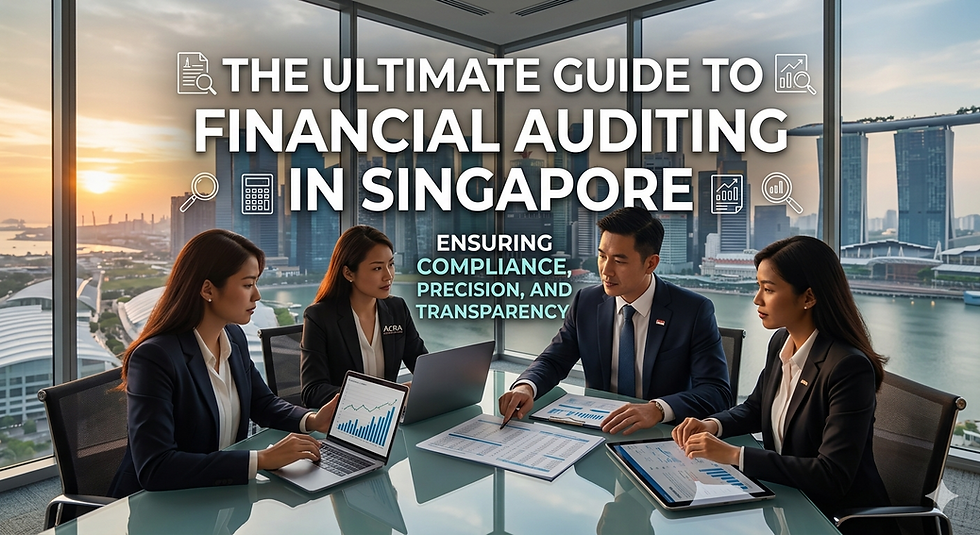
The Ultimate Guide to Financial Auditing in Singapore: Ensuring Compliance, Precision, and Transparency
In today’s rapidly evolving economic landscape, maintaining impeccable financial integrity is no longer just a regulatory obligation—it is a distinct competitive advantage. For businesses looking to scale, secure funding, or optimize operations, navigating complex regulatory framework requires more than standard bookkeeping. It demands precise, tailored auditing solutions.
Whether you are a fast-growing startup, an established Small to Medium Enterprise (SME), or a multinational corporation, understanding the strategic value of an audit can transform your financial practices from a compliance hurdle into a engine for business growth.
Explore our audit service for tailored auditing solutions that ensure your financial practices are precise, compliant, and transparent.
Why Modern Auditing is Moving Beyond Simple Compliance
Traditionally, financial auditing was viewed as a retrofitted, end-of-year look-back exercise designed solely to satisfy regulatory bodies like the Accounting and Corporate Regulatory Authority (ACRA) or the Inland Revenue Authority of Singapore (IRAS).
However, next-generation financial optimization treats the audit process as a forward-looking diagnostic tool. A precision-engineered audit provides:
Uncompromising Financial Transparency: By thoroughly validating your balance sheets, income statements, and cash flow tracking, an independent audit provides stakeholders, investors, and financial institutions with absolute confidence in your fiscal health.
Strict Regulatory Compliance: Singapore’s regulatory environment is dynamic. Tailored auditing ensures your business seamlessly aligns with the latest Singapore Financial Reporting Standards (SFRS) and international compliance metrics, completely mitigating the risk of costly penalties.
Operational Precision & Risk Mitigation: Modern auditing identifies internal control weaknesses, operational inefficiencies, and potential vulnerabilities before they impact your bottom line.
The Anatomy of a Tailored Auditing Solution
Every business possesses a unique operational blueprint. A retail enterprise requires entirely different oversight compared to a fintech startup or a regional logistics hub. Standard, one-size-fits-all checklists frequently miss the nuanced risk factors inherent to specific sectors.
A bespoke audit strategy adapts directly to your corporate structure, scaling with your growth. Key components of a comprehensive auditing framework include:
Statutory Audits: The mandatory evaluation of financial records to ensure compliance with ACRA regulations and statutory legal requirements.
Internal Audits & Control Optimizations: A granular assessment of your internal workflows, governance, and financial operations to protect assets and streamline efficiency.
Special-Purpose Audits: Targeted financial reviews—ranging from gross turnover audits for retail leases to grant verification audits—tailored to meet specific transaction or contractual needs.
Driving Growth and Valuation through Financial Transparency
For business owners and executives aiming for Mergers & Acquisitions (M&A), corporate restructuring, or capital fundraising, financial transparency is the primary driver of enterprise value.
When your financial practices are validated by precise auditing solutions, you drastically reduce the friction during due diligence. Clear, audited financial histories instantly signal to prospective buyers, partners, and institutional lenders that your business operates with corporate governance of the highest standard. It transforms abstract numbers into credible, bankable assets.
Optimize Your Financial Foundation Today
Financial precision is the bedrock of strategic business execution. Delaying your audit preparation or settling for generic accounting oversight leaves your enterprise vulnerable to compliance blind spots and operational leaks.
Empower your business with an auditing partner that understands your unique challenges and delivers customized, rigorous oversight. Discover how a dedicated approach can protect your assets, ensure regulatory adherence, and pave the way for sustainable growth.
Ready to elevate your financial practices? Explore our comprehensive audit service for tailored auditing solutions designed to deliver absolute precision, compliance, and transparency to your organization.
Frequently Asked Questions (FAQ)
1. Does my business in Singapore require a mandatory statutory audit?
Under the Singapore Companies Act, a company is exempt from audit requirements if it qualifies as a "small company" for the financial year. To qualify, it must meet at least two of the following three criteria in the immediate past two consecutive financial years:
Total annual revenue does not exceed S$10 million.
Total assets do not exceed S$10 million.
Total number of full-time employees does not exceed 50. If your company does not meet these criteria, a statutory audit is legally required.
2. What is the difference between internal and external auditing?
An external (statutory) audit focuses heavily on regulatory compliance, verifying that financial statements accurately reflect the company's financial position to external stakeholders. An internal audit evaluates internal governance, operational controls, and risk management processes to improve efficiency and protect company assets from within.
3. How long does a standard corporate audit typically take?
The duration depends entirely on the volume of transactions, the complexity of the business model, and the readiness of the company’s internal accounting records. A standard SME audit generally spans anywhere from a few weeks to a couple of months from initial planning to final report sign-off.
The Definitive Guide to Financial Auditing in Singapore: Ensuring Compliance, Precision, and Transparency
The Ultimate Guide to Financial Auditing in Singapore: Ensuring Compliance, Precision, and Transparency
In an increasingly complex corporate landscape, maintaining flawless financial integrity is no longer just a statutory checkbox—it is a cornerstone of business trust and enterprise value. For companies operating in or expanding through Singapore’s dynamic financial ecosystem, keeping pace with shifting regulatory frameworks requires more than standard bookkeeping. It demands sophisticated, customized oversight.
Whether you manage a rapidly scaling enterprise, a regional subsidiary, or a business preparing for its next major capital event, the right audit partner transforms a routine regulatory requirement into a powerful tool for strategic clarity.
Explore Bestar Singapore audit service for tailored auditing solutions that ensure your financial practices are precise, compliant, and transparent. Learn more at Bestar Services.
Why Modern Corporate Auditing Moves Beyond Compliance
Historically, financial auditing was viewed as a backward-looking exercise meant solely to satisfy regulators like the Accounting and Corporate Regulatory Authority (ACRA) and the Inland Revenue Authority of Singapore (IRAS).
Today, leading enterprises treat the audit as a forward-looking diagnostic mechanism. A precision-engineered audit provides three core pillars of business strength:
Uncompromising Financial Transparency: By rigorously validating balance sheets, income statements, and cash flows, an independent audit provides stakeholders, financial institutions, and potential investors with absolute confidence in your fiscal health.
Strict Regulatory Compliance: Singapore’s compliance guidelines evolve constantly. A tailored auditing approach ensures seamless alignment with the latest Singapore Financial Reporting Standards (SFRS) and international guidelines, mitigating risk and eliminating the exposure to costly statutory penalties.
Operational Precision & Risk Mitigation: Advanced auditing isolates vulnerabilities in internal controls, exposes hidden operational friction, and uncovers efficiencies that directly protect your bottom line.
The Anatomy of a Tailored Auditing Solution
Every industry carries a distinct risk profile and operational structure. A fast-moving digital platform, a regional manufacturing hub, and a logistics operation cannot be assessed using the same rigid checklist. One-size-fits-all approaches frequently overlook sector-specific risks or over-audit low-risk workflows.
A bespoke audit strategy adapts dynamically to your business model and scales alongside your corporate milestones. Key pillars of a robust corporate accounting framework include:
1. Statutory Financial Audits
The mandatory independent examination of accounting records to ensure complete compliance with the Singapore Companies Act and ACRA regulations. This process verifies that financial declarations offer a true and fair view of corporate performance.
2. Internal Audits & Workflow Optimization
A granular, voluntary look under the hood. Internal auditing focuses on identifying corporate governance gaps, streamlining financial reporting pipelines, and strengthening internal controls to shield assets against fraud or systemic oversight.
3. Special-Purpose Audits
Targeted financial reviews customized for specific events. These include gross turnover (GTO) audits for commercial retail leases, grant verification audits for government funding support, and targeted due diligence reviews.
Driving Corporate Valuation and Transaction Readiness
For business owners, founders, and executives aiming for Mergers & Acquisitions (M&A), corporate restructurings, or institutional fundraising, pristine financial reporting is the ultimate lever for unlocking enterprise value.
When your financial practices are thoroughly vetted by precise auditing solutions, you remove significant friction during due diligence. Clear, systematically audited financial histories signal to prospective buyers, joint-venture partners, and banks that your entity operates with top-tier corporate governance. It turns raw historical data into a credible, bankable asset that enhances deal confidence.
Secure Your Financial Foundation Today
Financial precision requires proactive execution. Leaving audit preparation to the last minute or relying on general accounting oversight exposes an organization to compliance blind spots and operational vulnerabilities.
Empower your business with an audit partner that combines local statutory expertise with an adaptable, detail-driven approach. Discover how a dedicated strategy can safeguard your assets, keep you in perfect alignment with regulators, and lay the foundation for sustainable corporate expansion.
Ready to elevate your financial practices? Explore Bestar Singapore audit service for tailored auditing solutions designed to deliver absolute precision, compliance, and transparency to your organization. Learn more at Bestar Services.
Frequently Asked Questions (FAQ)
1. Which companies in Singapore are required to undergo a statutory audit?
Under the Singapore Companies Act, companies must have their financial statements audited annually unless they qualify for the "small company" exemption. To meet this exemption, a company must satisfy at least two of the following three criteria for the immediate past two consecutive financial years:
Total annual revenue does not exceed S$10 million.
Total assets do not exceed S$10 million.
Total number of full-time employees does not exceed 50.
2. How does an internal audit differ from an external audit?
An external (statutory) audit focuses on validating the historical accuracy of financial statements for external stakeholders and ensuring full regulatory compliance. An internal audit is an operational tool focused inward, evaluating internal controls, governance structures, and risk management policies to maximize organizational efficiency.
3. What is the typical timeframe for a corporate audit?
The timeline depends heavily on the volume of transactions, corporate complexity, and the readiness of the company's internal bookkeeping records. A standard SME audit generally takes anywhere from a few weeks to a couple of months from the initial planning stage to the final signed audit report.


Comments