🇯🇵 Unlocking the Market: The Branch Office Operation in Japan for Foreign Businesses

Japan Branch Office Operations for Foreigners
The allure of the Japanese market—with its advanced economy, cutting-edge technology, and discerning consumers—is undeniable. For foreign companies ready to move beyond preliminary market research, establishing a formal operational base is the next crucial step. Among the primary options, the Japan Branch Office (Shiten) stands out as a direct and efficient way to begin generating revenue and executing full-scale commercial activities.
This guide explores the key operational aspects of setting up and running a Japan Branch Office, a critical structure for any company aiming for a tangible, profitable presence in the country.
Understanding the Japan Branch Office: A Direct Extension
Unlike a Japanese Subsidiary (like a Kabushiki Kaisha or Godo Kaisha), which is a separate legal entity, a Branch Office is legally viewed as a direct, non-independent extension of the foreign parent company. It is essentially an outpost that carries out activities as determined by the Head Office abroad.
Feature | Branch Office (Shiten) |
Legal Status | Not a separate legal entity; extension of the Head Office. |
Liability | All liabilities are borne directly by the foreign Head Office. |
Commercial Activity | Permitted (sales, contracting, revenue-generation). |
Registration | Required with the Legal Affairs Bureau. |
Capital | No minimum capital requirement in Japan. |
Representative | Must appoint at least one Representative in Japan (must be a resident). |
Key Operational Freedoms of a Branch Office
Choosing a Branch Office offers several operational benefits, allowing the foreign company to integrate its Japanese activities directly into its global structure:
1. Full Commercial Operations and Revenue Generation
The most significant advantage over a Representative Office is the right to conduct full for-profit commercial activities. This includes:
Sales and Distribution: Engaging directly with Japanese customers and vendors.
Contracting: Entering into legally binding contracts in the branch office's name.
Service Provision: Delivering professional, technical, or consulting services.
2. Legal & Administrative Functionality
Despite not being an independent entity, a registered Branch Office gains essential administrative capabilities:
Corporate Banking: The ability to open a corporate bank account in the branch's name, which is vital for local transactions and receiving Japanese customer payments.
Leasing Property: It can officially lease office space or property in the branch's name for its physical address.
Hiring Staff: It can hire local employees and must comply with Japanese labor law and social insurance requirements.
3. Financial and Tax Integration
The Branch Office structure simplifies the movement of funds and allows for immediate consolidation of financials:
Loss Offsetting: Any initial operating losses in Japan can often be offset against the parent company's profits in its home country's jurisdiction, a key tax advantage often cited for choosing a Branch Office.
Profit Remittance: Funds can generally be remitted back to the Head Office freely without the withholding tax that might apply to dividends from a subsidiary.
Japanese Tax Scope: The branch is only taxed in Japan on the income generated within Japan, though it must still file an annual corporate tax return.
Essential Registration & Management Requirements
To ensure your Branch Office is legally established and can operate smoothly in Japan, there are mandatory steps and roles:
Resident Representative: A legally required position, the representative must be a resident in Japan (holding a valid long-term visa). This individual acts as the legal face of the branch and handles all official registration and compliance matters.
Registered Address: A physical office address in Japan is required for registration and official correspondence. Virtual offices are sometimes accepted but can complicate banking procedures.
Registration Process: The official establishment requires submitting an application, notarized documentation (an Affidavit) from the parent company, and registration of the Branch Office's seal (Hanko) at the Legal Affairs Bureau. The process typically takes 4–7 weeks.
Choosing the Branch Office route offers a swift, cost-effective entry with direct operational control. By understanding its non-independent legal status and fulfilling the resident representative requirement, foreign businesses can quickly commence revenue-generating activities and establish a strong foothold in the Japanese market.
📝 Required Documentation for Japan Branch Office Registration
The registration process for a Japan Branch Office (Shiten) centers on establishing the foreign parent company's legal existence in Japan. The most critical and often complex document to prepare is the Affidavit.
Here is a breakdown of the specific documentation required, categorized by source:
1. Documents from the Foreign Parent Company (Head Office)
These documents confirm the legal status of the foreign entity and its decision to establish a branch in Japan.
Document | Purpose & Key Requirement |
Affidavit (宣誓供述書) | The most crucial document. This is a sworn statement, often consolidating key information about the foreign company and the branch's establishment. It must include: Company Name, Head Office Address, Governing Law, Business Purpose (scope of business), Total Capital, and the appointment of the Japan Representative. |
Notarization | The Affidavit must be signed by an authorized officer (CEO/Director) of the foreign company and notarized by a Public Notary or certified by an Embassy/Consulate of the Head Office's country. |
Articles of Incorporation (AoI) | A certified copy of the foreign company's current AoI (or equivalent foundational documents) is required to identify the nature of the company and its permitted business scope. |
Certificate of Incorporation/Registry | An official certificate proving the parent company's current and valid legal registration in its home country. |
Resolution to Establish Branch | A formal document (e.g., Minutes of the Board of Directors Meeting) formally approving the establishment of the Japan Branch Office and appointing the Japan Representative(s). |
Note: All documents issued in a foreign language must be accompanied by a complete Japanese translation.
2. Documents from the Japan Representative
The appointed resident representative is key to the registration process in Japan.
Document | Purpose & Key Requirement |
Proof of Residency | A copy of the Japan Representative's Residence Card (for foreign nationals) or other proof of having a residential address in Japan. |
Seal Certificate (印鑑証明書 - Inkan Shomeisho) | If the representative is a Japanese national or a foreigner with a registered personal seal (Jitsuin), this certificate from the local municipal office is required. |
Signature Attestation | For foreign nationals who do not have a registered personal seal in Japan, a notarized Signature Certificate or Signature Attestation from their country's embassy/consulate in Japan may be used as an alternative. |
3. Documents for the Branch Office Itself
These documents relate to the branch's location and its official legal mark in Japan.
Document | Purpose & Key Requirement |
Registered Office Address | A lease agreement, sub-lease agreement, or other proof of the branch office's physical address in Japan. A registered address is mandatory. |
Branch Office Seal(s) (Hanko) | The branch must have an official seal (Representative Seal) created and registered with the Legal Affairs Bureau. This seal acts as the branch's legal signature. |
Registration Application Forms | The prescribed application forms provided by the Japanese Legal Affairs Bureau (法務局 - Hōmukyoku). |
Payment of Registration Tax | Proof of payment for the Registration License Tax, which is ¥90,000 for a Branch Office with a determined address in Japan. |
Key Takeaway on Notarization and Timing
The biggest complexity often lies in the Affidavit process. It requires coordination between the foreign parent company and a certified public body (Notary or Consulate) in the Head Office's country. Any delay in notarization and translation will directly affect the overall setup timeline, which typically takes 4 to 7 weeks.
For an overview of the incorporation process in Japan, you may find this article useful:
Fees
Fees associated with the Branch Office registration process primarily involve government fees and costs for professional services and necessary items. The main government fee is the Registration License Tax.
Here is a breakdown of the typical fees and costs for setting up a Branch Office in Japan:
1. Government Fees (Mandatory)
The principal mandatory fee paid to the Japanese government during registration is the Registration License Tax.
Fee Type | Amount | Notes |
Registration License Tax | ¥90,000 | This fee is paid to the Legal Affairs Bureau upon application for the branch office registration. |
2. Essential Administrative Costs
These costs are necessary for preparing the required documentation and establishing the office's identity.
Cost Type | Amount | Purpose |
Notarization/Attestation Fees | ~$50 - $200 | Fees for having the Affidavit or other documents (like the Japan Representative's signature) notarized by a public notary or certified by a consulate. |
Translation Fees | Varies based on volume | Cost for translating the Head Office's documents (e.g., Articles of Incorporation, Certificate of Incorporation, Affidavit) into Japanese. |
Official Branch Seal (Hanko) | ~¥10,000 - ¥20,000 | Cost for manufacturing the official branch seal to be registered with the Legal Affairs Bureau. |
3. Professional Service Fees (Advisory)
Many foreign companies hire a professional firm to handle the complex documentation and filing process.
Cost Type | Amount | Notes |
Branch Office Registration Service Fee | ¥200,000 - ¥400,000+ | This fee covers the drafting of the Affidavit, preparing all application forms, handling translations, coordinating notarization, and filing the application with the Legal Affairs Bureau. |
Total Minimum Cost
Excluding professional service fees, a bare minimum for the mandatory government tax and essential physical items is approximately ¥100,000 (plus translation and notarization costs which vary by country).
Including professional service fees, the total cost for the registration process can range from ¥300,000 to over ¥500,000, depending on the complexity.
Fee for Nominee Resident Representative Service
The cost for a Nominee Resident Representative service in Japan is typically a recurring monthly fee charged by the professional firm providing the service.
Here is the general fee range for a nominee service from professional service providers in Japan:
Service Component | Monthly Fee (JPY) | Notes |
Nominee Resident Representative (Representative/Director) | ¥50,000 - ¥150,000 | This is a recurring fee for the individual to legally serve as the registered resident representative for the Branch Office. |
In addition to the monthly fee, firms may charge other, less frequent fees:
Setup Fee: An initial, non-recurring fee to establish the service and complete the necessary legal agreements and KYC (Know Your Customer) checks.
Ad-hoc Service Fees: Additional fees if the representative is required to attend bank interviews, sign complex contracts, or perform specific administrative tasks outside the basic scope.
Why This Service is Necessary for a Japan Branch Office
A foreign company establishing a Branch Office in Japan must appoint at least one Resident Representative in Japan. This individual is responsible for the legal and administrative matters of the branch.
For foreign businesses that do not yet have an expatriate living in Japan or a local Japanese hire ready for this role, professional firms offer a Nominee Resident Representative Service to fulfill this legal requirement, which is essential for:
Completing the official Branch Office registration with the Legal Affairs Bureau.
Assisting in the critical step of opening a corporate bank account in Japan.
Important Considerations
Scope of Service: Ensure the agreement clearly defines the representative's duties. This is usually a "name-only" service for legal compliance and is not an operational management service.
Duration: Nominee services are often temporary, intended to be used until your own personnel can take over the role after securing the appropriate work visa (like a Business Manager Visa) and establishing residency.
The article provided below offers a detailed explanation of the steps involved in forming a company in Japan, which can help you anticipate the associated costs.
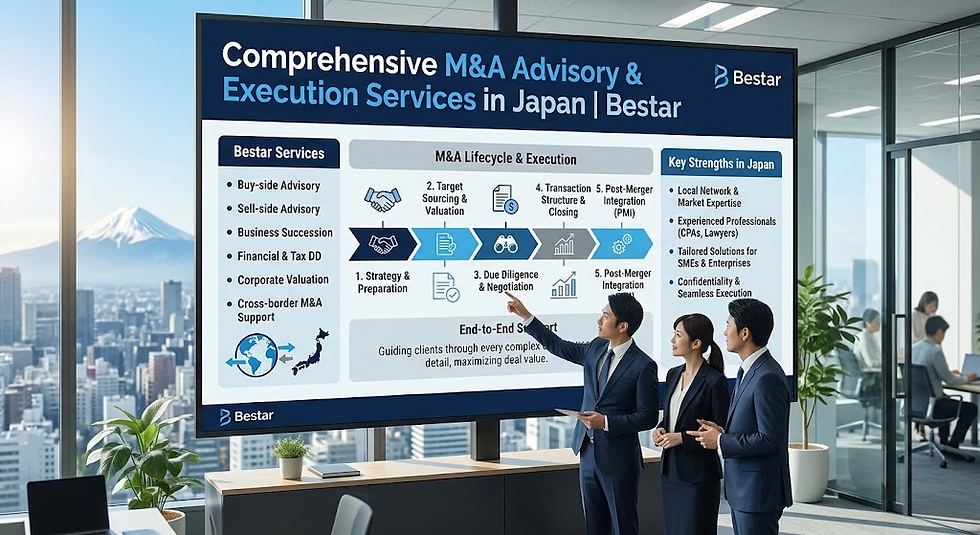
🇯🇵 Unlocking the Market: How Bestar Asia Can Help Foreign Businesses with Japan Branch Office Operation
🇯🇵 Unlocking the Market: The Branch Office Operation in Japan for Foreign Businesses
Seamless Japan Market Entry: Your Partner for Branch Office Success
Expanding your business into the world's third-largest economy requires expert guidance to navigate Japan's unique regulatory landscape. Establishing a Japan Branch Office is a cost-effective route, but the mandatory documentation and corporate compliance can be complex for foreign businesses.
Bestar Asia provides comprehensive, end-to-end solutions, positioning your company for a fast, compliant, and successful launch in the Japanese market. We turn bureaucratic challenges into a streamlined process, allowing you to focus on your core business strategy.
Bestar Asia's Specialized Services for Japan Branch Office Registration
Our expertise covers every stage of your Japan market entry, from the initial strategy to ongoing compliance.
1. Expert Entity Formation & Registration
We take the lead on the intricate registration process with the Japanese Legal Affairs Bureau (Hōmukyoku), ensuring all deadlines and requirements are met perfectly.
Affidavit Drafting & Notarization: We manage the preparation of the legally mandated Affidavit (宣誓供述書), coordinating the signing by the Head Office representative and securing the necessary notarization, including Japanese translation.
Documentation Management: We handle the preparation, certification, and Japanese translation of critical documents, such as the Articles of Incorporation and Certificate of Incorporation, saving you time and preventing rejection by authorities.
Japan Representative Support: We advise on the requirements for the Japan Representative (who must be a resident) and assist in registering their official seal (Jitsuin) or signature attestation.
2. Corporate Compliance & Ongoing Back-Office Support
A compliant establishment is just the first step. Bestar Asia ensures your Branch Office operation remains fully compliant with Japanese law.
Tax Advisory & Compliance: We guide your branch through initial tax registration and establish efficient tax planning strategies, ensuring compliance with Japan's corporate tax, consumption tax (VAT), and withholding tax regulations.
Accounting & Bookkeeping: Our specialized team provides accurate, Japanese GAAP-compliant accounting and bookkeeping services, essential for annual branch reporting.
HR & Payroll Outsourcing: We manage local payroll, social security contributions, and labor law compliance, reducing the administrative burden of hiring local staff in Japan.
Regulatory Filings: We ensure timely submission of all post-registration notifications to the National Tax Agency and other local authorities.
3. Strategic Market Entry Consulting
Beyond compliance, Bestar Asia helps you build a robust foundation for growth in Japan.
Optimal Structure Advice: We help you assess if a Branch Office is truly the best structure for your goals, or if a Subsidiary (KK or GK) might be a better long-term fit.
Risk Mitigation: We identify and help manage legal, regulatory, and cultural risks specific to launching an operation in Japan.
Banking Support: We assist in the often-challenging process of opening a corporate bank account for your newly registered Branch Office.
Why Choose Bestar Asia for Your Japan Expansion?
Feature | Bestar Asia Advantage | Benefit |
Local Expertise | Deep understanding of Japanese regulatory specifics and business customs. | Japan corporate compliance. |
Integrated Services | One partner for legal, tax, accounting, and payroll—from setup to operation. | Integrated services Japan market entry. |
Speed & Efficiency | Streamlined processes designed to accelerate your Branch Office registration timeline. | Fast Japan Branch Office setup. |
Ready to successfully launch your commercial operations in Japan?
Contact Bestar Asia today for a consultation on making your Japan Branch Office operation a success.
Actionable Tips:
Bilingual Keywords: A comprehensive strategy for the Japanese market should also include relevant Japanese terms, such as: 日本の支店設立 (Nihon no shiten setsuritsu - Japan branch office establishment) and 外国会社の日本進出 (Gaikoku-gaisha no Nihon shinshutsu - Foreign company Japan entry).
Focus on Comparison: Comparison tables (like the one above) that directly contrast the Branch Office with the Representative Office and Subsidiary, as users frequently search for Branch vs Subsidiary Japan.
Keywords: Japan Branch Office, Foreign Businesses, Market Entry Japan, Entity Formation, Corporate Compliance, Bestar Asia, Japan Branch Office, Branch Office in Japan, Business Operations Japan, setting up a branch office in Japan, Branch vs Subsidiary Japan, types of operation for foreign company in Japan, Japan corporate banking branch office


Comments