Singapore vs. Hong Kong Ship Financing
- Roger Pay
- Feb 3
- 11 min read
Ship Financing Singapore vs. Hong Kong
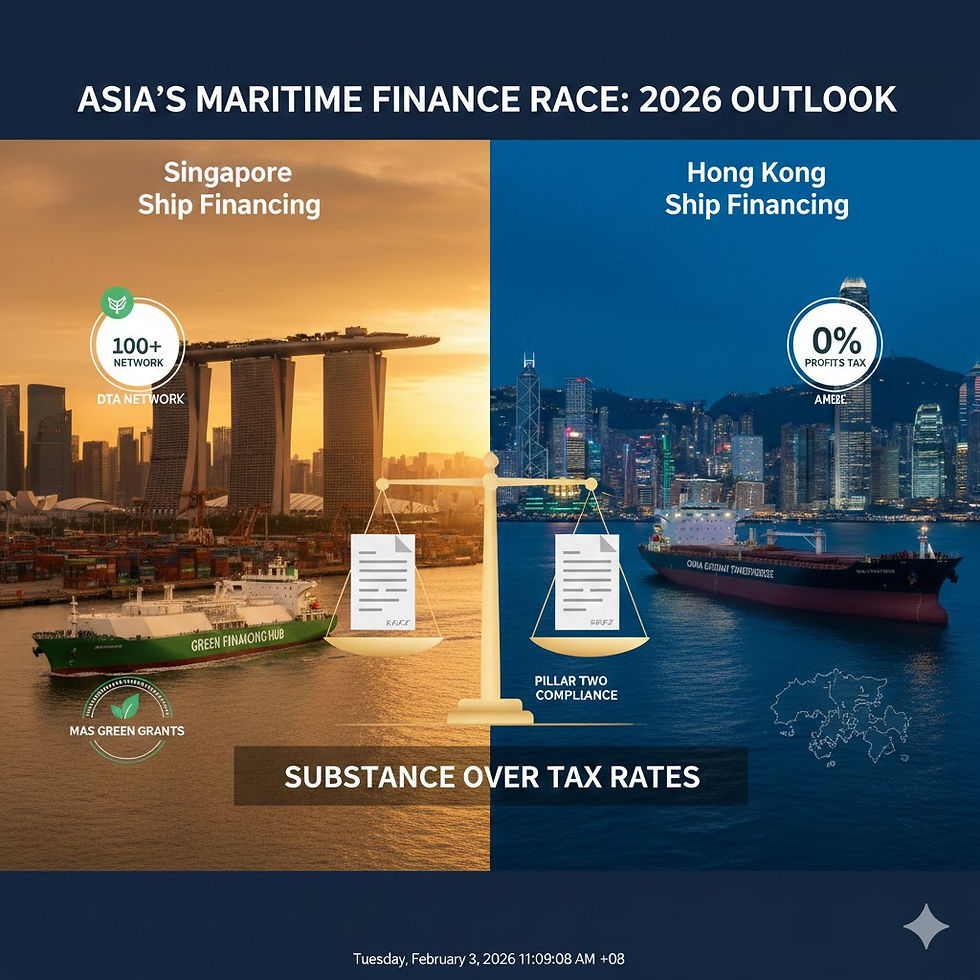
In 2026, the maritime industry faces a "perfect storm" of capital demands: decarbonization mandates, high-interest rates, and the implementation of Global Minimum Tax (Pillar Two). For shipowners and financiers, the choice between Singapore and Hong Kong is no longer just about geography; it is a strategic decision between a treaty-heavy hub and a China-gateway powerhouse.
1. Comparative Overview: Singapore vs. Hong Kong (2026)
While both cities offer competitive frameworks, they cater to different operational profiles.
Feature | Singapore | Hong Kong |
Primary Incentive | Maritime Sector Incentive (MSI) | Ship Leasing Tax Concession |
Effective Tax Rate | 0% to 10% (via MSI awards) | 0% (Lessors) / 8.25% (Managers) |
WHT on Interest | Exempt (with ASFA award) | 0% (Standard) |
Pillar Two Option | 15% (QDMTT implementation) | 15% (New election option) |
Access to China | Balanced/Neutral | Direct (Greater Bay Area) |
Treaty Network | 100+ Comprehensive DTAs | 45+ Comprehensive DTAs |
2. Ship Financing in Singapore: The Incentive Powerhouse
Singapore remains the top choice for global shipowners seeking a "middle ground" with robust legal protections and a deep pool of green financing.
Key Advantages:
Maritime Sector Incentive (MSI): The MSI-Maritime Leasing (MSI-ML) award provides a 0% tax rate on qualifying leasing income for up to 5 years (renewable).
Withholding Tax (WHT) Exemption: Under the Approved Shipping Financing Arrangement (ASFA), owners can enjoy WHT exemptions on interest payments for loans used to purchase or construct vessels.
Green Finance Leadership: Singapore leads in ESG-linked loans and transition financing, supported by MAS (Monetary Authority of Singapore) grants for sustainable bonds.
Insight: As of 2026, Singapore has solidified its position as the "Neutral Hub" for Western shipowners looking to de-risk from US-China trade tensions while maintaining access to ASEAN markets.
3. Ship Financing in Hong Kong: The Efficiency King
Hong Kong has aggressively refined its tax regime to reclaim its status as the premier ship leasing hub, particularly for entities linked to Mainland China.
Key Advantages:
0% Profits Tax for Lessors: Qualifying ship lessors pay 0% tax on profits derived from both operating and finance leases.
New 2026 Enhancements: Recent amendments have removed the one-year term restriction on leases, allowing short-term charters to qualify for the 0% rate.
Pillar Two Compliance: For MNEs (Multi-National Enterprises), Hong Kong now offers an optional 15% concessionary rate to simplify compliance with Global Minimum Tax rules without complex "top-up" calculations.
China Proximity: Unmatched for RMB-denominated financing and proximity to the world’s largest shipbuilders in the Pearl River Delta.
4. Strategic Decision: Which Should You Choose?
Choose Singapore if:
You require a vast Double Tax Agreement (DTA) network to minimize taxes on global freight income.
You are targeting growth in Southeast Asia, India, or Australia.
You need a stable, policy-driven environment with strong R&D incentives for maritime tech.
Choose Hong Kong if:
Your primary operations or financing sources are in Mainland China.
You want the simplest tax structure with no GST/VAT and minimal resident director requirements.
You are a ship lessor seeking a permanent 0% tax base with flexible "substance" requirements.
5. Summary of Incentives (2026 Update)
Singapore MSI-AIS: Focuses on ship operators establishing residency.
Hong Kong QSL: Focuses on leasing entities (SPVs) and management activities.
Interest Deductibility: Hong Kong’s new rules allow better interest deductions for groups borrowing from overseas headquarters.
Detailed tax-efficiency Simulation for a Vessel Acquisition (a $100M LNG Carrier) comparing both Singapore and Hong Kong
In 2026, the ship financing landscape is dominated by the Pillar Two Global Minimum Tax, which sets a floor of 15% for large multinational enterprise (MNE) groups (revenue over €750M). This has forced both Singapore and Hong Kong to pivot from "pure tax havens" to "substance-heavy hubs."
Here is a detailed simulation for a $100M LNG Carrier acquisition.
1. The Scenario: $100M LNG Carrier Financing
Asset: 174,000 cbm LNG Carrier.
Financing: $70M Senior Debt (5% Interest) | $30M Equity.
Revenue: $80,000/day Time Charter (approx. $29M/year).
Jurisdictions: Singapore (via MSI-ML) vs. Hong Kong (via QSL).
Financial Impact Table (Estimated Annual)
Component | Singapore (MSI-ML) | Hong Kong (QSL) |
Corporate Tax on Leasing Income | 0% (Award-based) | 0% (Statutory) |
Interest Withholding Tax (WHT) | 0% (via ASFA exemption) | 0% (Standard) |
Depreciation/Capital Allowance | Accelerated (1–3 years) | Tax Deduction on acquisition cost |
Pillar Two Top-up Tax | 15% (Effective 2025/26) | 15% (Optional election) |
Treaty Benefits (WHT on Charter) | High (100+ DTAs) | Moderate (45+ DTAs) |
2. Deep Dive: Singapore (The Stability Choice)
Singapore’s Maritime Sector Incentive - Maritime Leasing (MSI-ML) is the "gold standard" for diversified fleets.
ASFA Exemption: This is critical. For a $100M ship, the interest on a $70M loan is roughly $3.5M/year. Without the ASFA (Approved Shipping Financing Arrangement) award, Singapore would charge 15% WHT on that interest ($525,000). MSI-ML holders typically get this waived.
Decarbonization Credits: In 2026, Singapore offers enhanced tax deductions for "Green Ships" (EEDI Phase 3 compliant), which can be used to offset other group-level taxes.
Pillar Two Strategy: Singapore has implemented the QDMTT (Qualified Domestic Minimum Top-up Tax). If your effective rate is 0%, you pay the 15% in Singapore rather than to a foreign tax authority.
3. Deep Dive: Hong Kong (The Efficiency Choice)
Hong Kong’s Qualifying Ship Leasing (QSL) regime is the world’s most streamlined "zero-tax" system for pure lessors.
No Resident Director: Unlike Singapore, Hong Kong does not require a local resident director, saving roughly $5,000–$10,000/year in nominee fees and simplifying board management.
Interest Deductibility: As of 2025/26, Hong Kong has relaxed rules for interest paid to overseas associates. If you borrow $70M from a parent in a 15%+ tax jurisdiction, the interest expense is now fully deductible against HK profits.
GBA Connectivity: For LNG carriers servicing China’s state-owned enterprises (e.g., CNOOC, Sinopec), HK-based financing often qualifies for preferred "domestic" status under certain Mainland trade protocols.
4. Pillar Two: The Great Leveler
For MNE groups with revenue over €750M, the "0% tax" in both cities is effectively 15% from 2025 onwards.
Expert Tip: In 2026, the competition has shifted from Tax Rates to Substance Benefits. Singapore is winning on Green Financing grants, while Hong Kong is winning on Operational Simplicity and lower compliance costs for China-bound cargo.
5. Strategic Recommendation
Use Singapore if your charterers are global (EU/US/ASEAN) and you need the 100+ treaty network to ensure charter hire is not taxed at the source.
Use Hong Kong if you are a leasing SPV backed by Chinese capital or if your vessel will primarily operate on the Australia-China or Middle East-China LNG routes.
Side-by-side Compliance Checklist for Setting Up a Maritime SPV in both Cities
In 2026, setting up a Maritime Special Purpose Vehicle (SPV) requires a shift from "paper management" to "real-world substance." Below is the side-by-side compliance checklist for establishing and maintaining a $100M ship financing structure in both hubs.
1. Pre-Incorporation & Setup Checklist
Requirement | Singapore (Maritime SPV) | Hong Kong (Maritime SPV) |
Director Residency | Mandatory: At least 1 resident director (Citizen/PR/Pass holder). | Flexible: 100% foreign directors allowed. |
Company Secretary | Must be an individual resident. | Can be a licensed corporate entity. |
Minimum Capital | S$1(S$5M+ suggested for MSI status). | HK$1 (No minimum statutory capital). |
Incorporation Time | 1–3 business days. | 1 business day (via e-Registry). |
Audit Exemption | Small Company Exception: Revenue <S$10M & Assets <S$10M. | None: Mandatory annual audit for all companies. |
2. Tax Incentive Compliance (The "Substance" Test)
To maintain the 0% tax status on leasing income, you must meet specific 2026 economic substance thresholds:
Singapore (MSI-ML Award)
Annual Spending: Usually a minimum local business spending (TBE) of S$200,000+ is expected for the group.
Local Employment: Expectation of at least 1–2 shipping professionals based in Singapore.
Approval: Requires a formal application and approval from the Maritime and Port Authority (MPA).
Hong Kong (QSL Regime)
Operating Expenditure: Minimum HK$7.8 million (~US$1M) per year for the leasing activity.
Local Employment: Minimum 2 qualified full-time employees in Hong Kong.
Management & Control: Board meetings and strategic decisions must physically occur in Hong Kong to qualify for the 0% rate.
3. Annual Maintenance & Regulatory Filing
Singapore (ACRA & IRAS)
Annual Return (AR): Filed within 7 months of Financial Year End (FYE).
Tax Filings (Form C-S/C): Due by Nov 30 (paper) or Dec 15 (e-filing).
Common Reporting Standard (CRS): Mandatory registration by March 31 and filing by May 31.
MSI Reporting: Annual data collection by the MPA to verify the vessel's qualifying status.
Hong Kong (Registry & IRD)
Annual Return (NAR1): Filed within 42 days of the incorporation anniversary (strict deadline).
Business Registration (BRC): Annual or 3-year renewal required.
Profits Tax Return (PTR): Usually issued in April; must be filed within 1 month (extensions possible with an auditor).
Pillar Two Election: If electing the 15% concessionary rate for 2026, this must be filed by June 30, 2026.
4. Operational Compliance (2026 Standards)
IHM Certification: Following the Hong Kong Convention entering into force in late 2025, all SPVs must maintain an International Certificate on Inventory of Hazardous Materials (ICIHM).
UBO Register: Both jurisdictions require a Register of Significant Controllers/Registrable Controllers to be maintained at the registered office for AML (Anti-Money Laundering) transparency.
Pro Tip for 2026: If your group revenue exceeds €750M, the compliance "paperwork" increases 5x due to Global Minimum Tax (Pillar Two). You will need to provide over 200 data points per SPV to prove your Effective Tax Rate (ETR).
Total Cost of Ownership (TCO) comparison for the first Three Years of running an SPV in these Two Cities
In 2026, the Total Cost of Ownership (TCO) for a maritime SPV is shaped by a "Substance Paradox": while Hong Kong is cheaper to incorporate, its mandatory audit and strict new substance spending requirements for tax concessions can close the gap with Singapore.
Below is the 3-year TCO projection for a single-vessel SPV (Asset Value: $100M).
1. 3-Year TCO Comparison (USD Estimates)
Expense Category | Singapore (MSI-ML) | Hong Kong (QSL) |
Year 1: Setup & Launch | ~$12,000 – $18,000 | ~$6,500 – $9,000 |
Year 2: Operational Maintenance | ~$35,000 – $50,000 | ~$40,000 – $55,000 |
Year 3: Operational Maintenance | ~$35,000 – $50,000 | ~$40,000 – $55,000 |
3-Year Cumulative Total | $82,000 – $118,000 | $86,500 – $119,000 |
Key Cost Drivers in 2026:
Singapore: Higher costs are driven by the Nominee Director requirement ($3,000–$5,000/year) and the rigorous MPA application fees for MSI status.
Hong Kong: Higher recurring costs stem from the mandatory statutory audit (which can reach $10,000+ for active shipping firms) and the minimum local spending ($1M USD/year) required to maintain the 0% tax concession.
2. Breakdown of Annual Recurring Costs
The "Substance" Factor
In 2026, you cannot simply have a "letterbox" company. To qualify for the tax incentives discussed previously:
Singapore (MSI-ML): You need to demonstrate at least S$200,000 (US$150k) in local business spending. This is often achieved through ship management fees paid to a Singapore-based manager.
Hong Kong (QSL): The threshold is higher at HK$7.8M (US$1M) in operating expenditure. However, HK allows you to "outsource" this substance to a local service provider or an affiliate, provided the activities are performed in HK.
3. Hidden Savings & "Value-for-Money"
Singapore’s "Treaty Alpha"
While Singapore's setup is pricier, its 100+ Double Tax Agreements (DTAs) often save millions in withholding taxes on charter hire.
Example: If your vessel charters to an Indonesian or Indian entity, Singapore's treaty can reduce WHT from 20% down to 0-10%, potentially saving $500k+ per year—far outweighing the $50k maintenance cost.
Hong Kong’s "Structural Lean"
If your group is not an MNE (revenue <€750M), Hong Kong is significantly easier to manage. There is no Goods and Services Tax (GST) to file, and the lack of a resident director requirement allows for a much more agile "remote" board structure.
4. 2026 TCO Strategy: The Verdict
Best for Large Fleets: Singapore. The cost per SPV drops as you scale because you can centralize "Substance" (staff/office) across 10+ vessels.
Best for Single-Ship SPVs: Hong Kong. The initial barrier to entry is lower, and the legal framework is more flexible for "buy-and-leaseback" structures involving Chinese banks.
Sample Board Resolution for the Incorporation of an SPV in either Singapore or Hong Kong
In 2026, board resolutions for maritime SPVs must explicitly reference "Substance" and "Tax Incentive Intent" to satisfy anti-avoidance audits (Pillar Two).
Below is a professional template that can be adapted for either Singapore or Hong Kong. The bracketed text indicates where specific jurisdictional nuances apply.
Sample Board Resolution: Incorporation of Maritime SPV (2026)
[PARENT COMPANY NAME]
(Incorporated in [Parent Country])
(the "Company")
MINUTES OF A MEETING OF THE BOARD OF DIRECTORS HELD VIA [LOCATION/PLATFORM] ON [DATE] 2026
1. PROPOSAL: INCORPORATION OF SHIPPING SPV
The Chairman noted the proposal to incorporate a wholly-owned subsidiary in [Singapore / Hong Kong] (the "SPV") for the purpose of acquiring, financing, and leasing one (1) LNG Carrier (the "Vessel").
2. STRATEGIC INTENT & TAX CONCESSIONS
IT WAS NOTED THAT the SPV is intended to qualify for:
[Singapore]: The Maritime Sector Incentive – Maritime Leasing (MSI-ML) award under the Income Tax Act 1947.
[Hong Kong]: The Qualifying Ship Leasing (QSL) tax regime under the Inland Revenue Ordinance (Cap. 112).
IT WAS FURTHER RESOLVED THAT the SPV shall maintain sufficient economic substance in the jurisdiction, including the appointment of qualified personnel and meeting the minimum annual local business spending of [S$200,000/HK$7,800,000].
3. APPOINTMENT OF OFFICERS
IT WAS RESOLVED THAT the following persons be appointed as initial directors of the SPV:
Director A: [Name]
Director B: [Name]
[Note: Singapore requires at least one local resident director]
4. BANKING & FINANCING
IT WAS RESOLVED THAT the Directors of the SPV be authorized to:
Open corporate bank accounts with [Bank Name] in the SPV's name.
Negotiate and execute a Senior Debt Facility of up to $70,000,000 for the Vessel acquisition.
Enter into a Bareboat Charter or Ship Leasing Agreement as the "Lessor."
5. EXECUTION OF DOCUMENTS
IT WAS RESOLVED THAT any Director be authorized to sign all incorporation documents, including the Constitution/Articles of Association, and to lodge the same with [ACRA (Singapore) / Companies Registry (Hong Kong)].
Comparison Table: Jurisdiction-Specific Clauses
Clause Topic | Singapore (Specifics) | Hong Kong (Specifics) |
Legal Reference | Refer to Companies Act 1967 | Refer to Companies Ordinance (Cap. 622) |
Resident Director | Resolution must name at least one Singapore Citizen/PR. | No residency required (can be all foreign). |
Common Seal | Use of Seal is optional; execution by signature is standard. | Use of Common Seal is optional (most use "Chops"). |
Share Capital | Usually issued in USD for shipping SPVs. | Usually issued in HKD or USD. |
Next Steps for Your Legal Team:
KYC Package: Prepare the UBO (Ultimate Beneficial Owner) register for the parent company, as both registries now require 2026-standard AML transparency.
Registered Office: Ensure the resolution specifies the local registered address (a "PO Box" is not sufficient for tax substance in 2026).
How Bestar Asia Can Help
Singapore vs. Hong Kong Ship Financing
In 2026, navigating capital-intensive ship financing in Singapore and Hong Kong requires more than just a filing agent; it requires a strategic partner who understands the "Substance-First" regulatory era.
Bestar Asia serves as a specialized bridge for shipowners, lessors, and financiers, ensuring that high-value maritime structures remain compliant, tax-efficient, and audit-ready.
1. Navigating the "Substance" Requirements
As of 2026, both the Singapore MSI and Hong Kong QSL regimes have strict local spending and headcount thresholds. Bestar Asia helps you meet these through:
Substance-as-a-Service: Assisting with the recruitment of qualified shipping professionals and securing physical office space to satisfy the MPA (Singapore) and IRD (Hong Kong) "Management and Control" tests.
Outsourced Compliance: Managing the required local business spending (TBE) through integrated accounting and corporate secretarial services.
2. Tax Advisory & Pillar Two Readiness
With the Global Minimum Tax (15%) now active for large MNEs, Bestar Asia provides critical "Top-up Tax" simulations:
MSI & QSL Optimisation: Structuring your maritime SPVs to ensure that even with Pillar Two, you maximize available local credits and "Substance-based Income Exclusions" (SBIE).
WHT Mitigation: Leveraging Singapore’s 100+ DTA network to ensure that interest payments on multi-million dollar ship loans are not eroded by international withholding taxes.
3. Full-Spectrum Maritime SPV Management
Bestar Asia acts as a single point of contact for the entire lifecycle of a ship-owning entity:
Incorporation & Licensing: Fast-tracked setup in both hubs, including the critical Approved Shipping Financing Arrangement (ASFA) applications in Singapore.
Multi-Currency Accounting: Handling complex maritime bookkeeping (freight, charter hire, and bunker costs) across USD, SGD, and HKD.
Nominee Services: Providing qualified Resident Directors in Singapore to meet statutory mandates while maintaining the group’s operational confidentiality.
Why Bestar Asia? (2026 Competitive Edge)
Bestar Asia Advantage | Impact for Shipowners |
Dual-Hub Expertise | Seamlessly compare and move assets between SG and HK as market conditions shift. |
Pillar Two Specialists | Advanced data-gathering for GloBE (Global Anti-Base Erosion) reporting requirements. |
Direct MPA/IRD Liaison | Professional representation during annual incentive reviews and tax audits. |
Cost Efficiency | "Goldilocks" pricing—more personalized than the "Big 4" but more technical than standard secretaries. |
Strategy Note: For 2026, Bestar Asia specifically recommends Singapore for owners seeking Green Finance subsidies and Hong Kong for those integrated into the Greater Bay Area shipbuilding supply chain.


Comments