US Check-the-Box Election 75-Day Rule
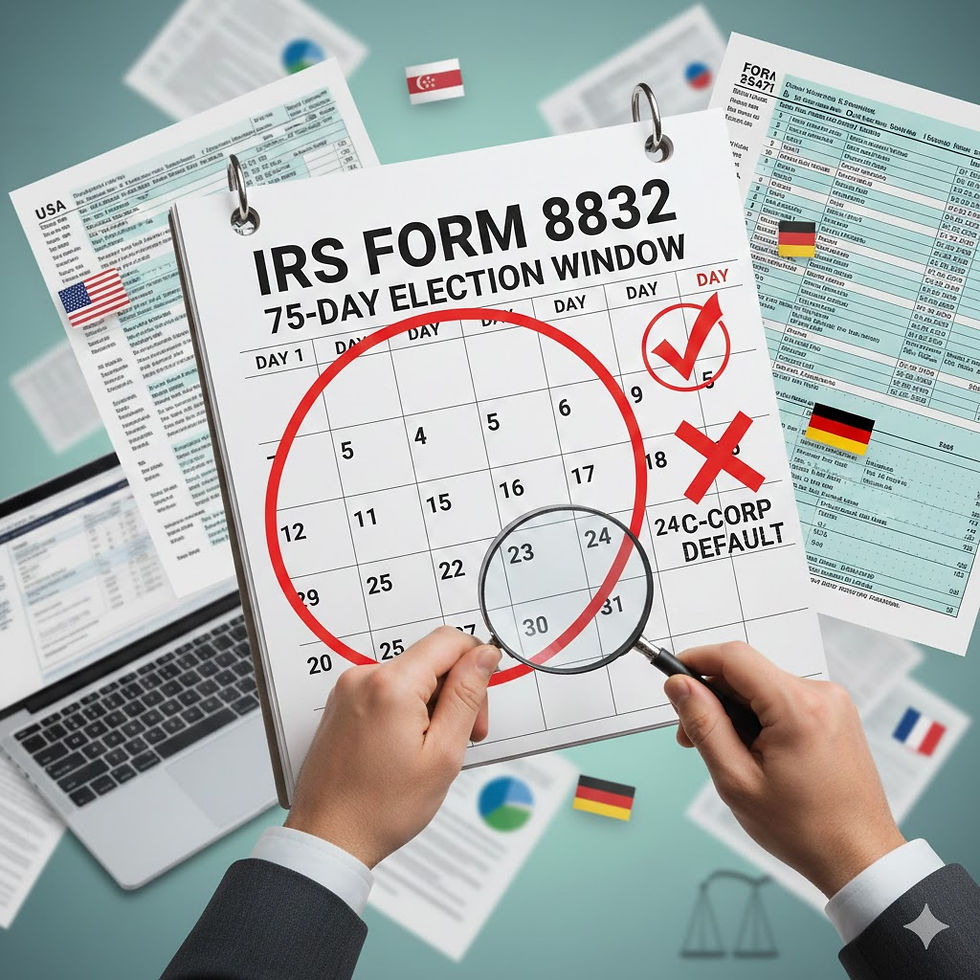
US "Check-the-Box" Elections: Navigating the 75-Day IRS Window
US Check-the-Box Election 75-Day Rule
For US-resident beneficiaries of foreign entities, tax classification is a high-stakes game. Without proactive steps, the IRS may default your entity to a "C-Corp" classification, leading to double taxation and complex reporting requirements (like Form 5471).
The solution? IRS Form 8832, commonly known as the "Check-the-Box" election. This allows eligible entities to choose their federal tax classification, but there is a strict "75-day window" that can make or break your tax strategy.
Why the "Check-the-Box" Election Matters
By default, the IRS classifies foreign entities based on the liability of their members. If all members have limited liability, the IRS typically views the entity as an association taxable as a C-Corporation.
By filing Form 8832, a US-resident beneficiary can elect to treat the entity as:
A Disregarded Entity: If there is a single owner (treated as a sole proprietorship for tax purposes).
A Partnership: If there are two or more owners (flow-through taxation).
The Benefit: You avoid the corporate-level tax and potentially bypass the most onerous anti-deferral regimes (like PFIC or CFC rules) by ensuring income flows directly to your individual return.
The Critical 75-Day Timing Rule
The IRS is incredibly strict regarding the Effective Date of the election. To ensure your classification is valid from the desired start date, you must understand the "75-day look-back" rule.
Rule Type | Limitation |
|---|---|
Retroactive Limit | The election cannot take effect more than 75 days prior to the date the form is filed. |
Prospective Limit | The election cannot take effect more than 12 months after the date the form is filed. |
Warning: If you file Form 8832 on Day 76, the IRS will not honor your requested start date. Instead, the election will become effective on the filing date, potentially leaving a 76-day "gap" where the entity was taxed as a C-Corp.
How to Avoid Inadvertent C-Corp Classification
For a US-resident beneficiary, an accidental C-Corp classification is a compliance nightmare. Here is how to stay protected:
Identify the "Trigger Event": The clock usually starts the moment a US person acquires an interest in a foreign entity or when the entity is formed.
Verify Eligibility: Ensure the entity is not a "Per Se" corporation (certain foreign entities, like a UK PLC or a German AG, are always treated as corporations and cannot check the box).
File Form 8832 Promptly: Aim to file within 60 days of the trigger event to provide a safety buffer for the 75-day deadline.
Late Election Relief: If you missed the 75-day window, you might qualify for "Late Election Relief" under Revenue Procedure 2009-41, provided you haven't yet filed a tax return inconsistent with the requested classification.
Maximizing Your Tax Efficiency
Don't let administrative deadlines dictate your tax liability. Properly timing your Form 8832 election ensures that foreign losses can be used to offset US income and that you avoid the "Double Tax" trap of corporate distributions.
Key Takeaway: The "Check-the-Box" election is a powerful tool for transparency, but it is entirely dependent on the calendar.
Would you like me to draft a checklist of the specific documents and information you'll need to gather before filling out Form 8832?
aft a checklist of the specific documents and information you'll need to gather before filling out Form 8832
To file IRS Form 8832 successfully, especially for a foreign entity, you must have precise data to satisfy both the IRS’s identification requirements and its strict 75-day timing rules.
Below is a comprehensive checklist of the documents and information you should gather before you begin the filing process.
1. Core Entity Information
The IRS needs to uniquely identify the entity. Even if the entity is foreign, it must have a US tax identification number to file this form.
Legal Name of Entity: Exactly as it appears on organizational documents (e.g., Articles of Association).
Employer Identification Number (EIN): You cannot leave this blank. If you don't have one, you must file Form SS-4 first.
Address: The principal place of business or office address.
Jurisdiction of Formation: The country or province where the entity was legally organized.
2. Owner & Member Details
Classification depends on the number of owners and their liability status.
Number of Owners: You must provide the exact count of members on the effective date.
Owner Identification: Names and Taxpayer Identification Numbers (SSN, ITIN, or EIN) for all current owners.
Liability Status: Determination of whether members have "limited liability" under local law (this is critical for determining the default classification).
3. Classification Selection Data
You need to be clear about where you are coming from and where you are going.
Current Classification: Is the entity currently a corporation, partnership, or disregarded entity?
Type of Election:
Initial classification by a newly formed entity.
Change in current classification.
The "Effective Date": The specific date you want the new status to begin. (Must be within the 75-day look-back or 12-month look-forward window).
4. Supporting Legal Documents
While you don't always mail these to the IRS, you need them to answer Form 8832 questions accurately:
Organizational Documents: To verify if the entity is a "Per Se" corporation (e.g., a UK PLC or German AG), which would make it ineligible for the election.
Authorized Signature Proof: Documentation (like an Operating Agreement or Board Resolution) proving that the person signing the form is an authorized officer, manager, or member.
5. Late Election Relief (If Applicable)
If you are filing more than 75 days after your desired effective date:
Reasonable Cause Statement: A detailed, written explanation for why the election was late.
Tax Return History: Evidence that all relevant federal tax returns have been filed consistently with the requested classification since the desired effective date.
Summary Table for Quick Reference
Requirement | Details Needed |
Tax ID | A valid US EIN (Mandatory). |
Signatures | All members OR one authorized officer/manager. |
Location | Country of organization (for foreign entities). |
The "Window" | A date no more than 75 days in the past. |
Determine if your Foreign Entity is considered "Per Se" (ineligible) or an "Eligible Entity"
To determine if your foreign entity is an "Eligible Entity" or a "Per Se" corporation, you must look at Treasury Regulation §301.7701-2(b)(8).
The IRS maintains a specific list of foreign business entities that are always treated as corporations for US federal tax purposes. If your entity type is on this list, you cannot "check the box" to be treated as a partnership or disregarded entity.
1. The "Per Se" Corporation List
If your entity is organized in any of the following jurisdictions with the corresponding designation, it is a Per Se Corporation:
Country | Entity Designation (Per Se) |
Australia | Public Limited Company |
Canada | Corporation and Company |
China (PRC) | Gufen Youxian Gongsi |
France | Société Anonyme |
Germany | Aktiengesellschaft (AG) |
Hong Kong | Public Limited Company |
Israel | Public Limited Company |
Japan | Kabushiki Kaisha |
Mexico | Sociedad Anónima |
Singapore | Public Limited Company |
Switzerland | Aktiengesellschaft / Société Anonyme |
United Kingdom | Public Limited Company (PLC) |
Note: This is an abbreviated list. The full regulation includes over 80 jurisdictions. If you see "Public Limited Company" or "Sociedad Anónima," it is a red flag for Per Se status.
2. Identifying "Eligible Entities"
An entity is "eligible" to make an election if it is not on the Per Se list. Common examples of eligible foreign entities include:
UK: Private Limited Company (Ltd)
Germany: Gesellschaft mit beschränkter Haftung (GmbH)
France: Société à Responsabilité Limitée (SARL)
Mexico: Sociedad de Responsabilidad Limitada (SRL)
Canada: Nova Scotia Unlimited Liability Company (ULC)
3. The "Default" Trap for Eligible Entities
Even if your entity is "eligible," the IRS has default classifications that apply if you do not file Form 8832. For foreign entities, the default depends on whether members have limited liability:
Default Corporation: If all members have limited liability (very common for foreign "Limited" companies), the IRS defaults the entity to a C-Corp.
Default Partnership: If at least one member has unlimited liability and there are two or more members.
Default Disregarded Entity: If there is a single owner and that owner has unlimited liability.
Summary Rule of Thumb
Check the List: If it’s a "Public" type entity (PLC, AG, SA), it’s likely Per Se (Ineligible).
Check Liability: If it's a "Private" limited entity, it is likely Eligible, but it will default to a Corporation unless you file Form 8832 within the 75-day window.
Would you like to look up a specific country and entity type to confirm its status?
How Bestar Asia can Help
US Check-the-Box Election 75-Day Rule
In the complex world of international tax, the "Check-the-Box" election is a powerful tool to prevent double taxation. However, the 75-day IRS window is unforgiving. Missing this deadline can lead to an inadvertent C-Corp classification, triggering complex reporting (Form 5471) and higher tax liabilities for US residents.
Bestar Asia specializes in bridging the gap between foreign operations and US tax compliance, ensuring your entity classification is proactive rather than reactive.
How Bestar Asia Secures Your 75-Day Election
Navigating IRS Form 8832 requires more than just filling out a form; it requires a strategic understanding of both local entity laws and US tax regulations. Bestar Asia provides the following critical support:
1. Pre-Election Entity Analysis
Before filing, Bestar reviews your foreign entity (e.g., Singapore Pte Ltd, Hong Kong Ltd) to determine its status.
"Per Se" Check: We confirm if your entity is on the IRS "ineligible" list.
Default Analysis: We identify what your classification will be if no action is taken, protecting you from the "Default Corporation" trap.
2. Precise Timing & Window Management
The 75-day rule is the most common point of failure for US-resident beneficiaries. Bestar manages this timeline by:
Trigger Event Monitoring: We track the exact date a US person acquires an interest or when the entity becomes "relevant" to the US tax system.
Rapid EIN Procurement: Since an Employer Identification Number (EIN) is mandatory for Form 8832, we expedite the SS-4 application process to ensure you aren't held up by administrative delays.
3. Comprehensive Compliance Integration
A "Check-the-Box" election changes your entire reporting profile. Bestar ensures your local books and US tax filings are aligned:
Flow-Through Accuracy: If electing Disregarded Entity or Partnership status, we ensure income and expenses are captured for your US individual return (Form 1040).
Avoidance of PFIC/CFC Status: We structure the election to help you bypass the punitive Passive Foreign Investment Company (PFIC) or Controlled Foreign Corporation (CFC) regimes.
4. Late Election Relief (Rev. Proc. 2009-41)
If you have already missed the 75-day window, Bestar can evaluate your eligibility for Late Election Relief. We assist in drafting the required "Reasonable Cause" statement and ensuring that all tax returns are filed consistently with the requested classification to satisfy IRS requirements for retroactive approval.
Why Choose Bestar Asia?
Global Perspective: We understand the nuances of Asian entity structures and how they translate to US tax law.
One-Stop Compliance: From Singapore ACRA filings to IRS Form 8832, we handle the entire cross-border lifecycle.
Risk Mitigation: We focus on "Check-the-Box" strategies that maximize Foreign Tax Credits (FTC) and minimize the "double tax" on corporate profits.
Would you like Bestar Asia to perform a "Classification Health Check" on your foreign entity to see if a Check-the-Box election is necessary?


Comments